
Ch.6 - Electronic Structure of Atoms
Brown - Chemistry: The Central Science 15th Edition
Brown15th EditionChemistry: The Central ScienceISBN: 9780137542970Non è quello che usi tu?Cambia libro di testo
Capitolo 6, Problema 35

Does the hydrogen atom 'expand' or 'contract' when an electron is excited from the n = 1 state to the n = 3 state?

Guida verificata passo dopo passo
1
Understand the concept of electron orbitals in a hydrogen atom. The principal quantum number, 'n', indicates the size and energy of the orbital where the electron resides.
Recognize that as the principal quantum number 'n' increases, the electron moves to a higher energy level, which is further away from the nucleus.
Relate the distance of the electron from the nucleus to the size of the electron cloud or orbital. A higher 'n' value means a larger orbital.
Conclude that when an electron is excited from a lower energy level (n = 1) to a higher energy level (n = 3), it moves to an orbital that is further from the nucleus.
Determine that the hydrogen atom 'expands' because the electron occupies a larger orbital when it is excited from the n = 1 state to the n = 3 state.

Risposta video verificata per un problema simile:

Questa soluzione video è stata consigliata dai nostri tutor come utile per risolvere questo problema.
Durata del video:
4m

Concetti chiave

Ecco i concetti essenziali che devi comprendere per rispondere correttamente alla domanda.

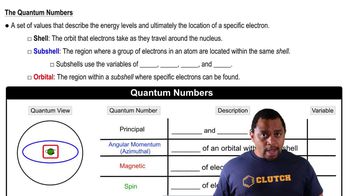
Quantum States

Quantum states refer to the specific energy levels that electrons occupy in an atom. Each state is characterized by a principal quantum number (n), which indicates the energy level and distance from the nucleus. For hydrogen, the n = 1 state is the ground state, while n = 3 is an excited state, where the electron is further from the nucleus and has higher energy.
Video consigliato:
Percorso guidato
03:22
Quantum Numbers

Electron Excitation

Electron excitation occurs when an electron absorbs energy and transitions from a lower energy level to a higher one. In the case of hydrogen, moving from n = 1 to n = 3 means the electron gains energy, which can be provided by various sources such as heat or light. This process results in the electron being in a less stable, higher energy state.
Video consigliato:
Percorso guidato
04:44
Electron Geometry

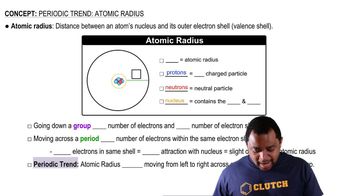
Atomic Radius

The atomic radius is a measure of the size of an atom, typically defined as the distance from the nucleus to the outermost electron shell. When an electron is excited to a higher energy level, such as from n = 1 to n = 3, the average distance of the electron from the nucleus increases, effectively causing the atom to 'expand' in size due to the electron's higher energy state.
Video consigliato: