
Ch.6 - Electronic Structure of Atoms
Brown - Chemistry: The Central Science 15th Edition
Brown15th EditionChemistry: The Central ScienceISBN: 9780137542970Non è quello che usi tu?Cambia libro di testo
Capitolo 6, Problema 33c

Molybdenum metal must absorb radiation with a minimum frequency of 1.09 * 1015 s - 1 before it can eject an electron from its surface via the photoelectric effect. (c) If molybdenum is irradiated with light of wavelength of 120 nm, what is the maximum possible kinetic energy of the emitted electrons?

Guida verificata passo dopo passo
1
Identify the given values: the minimum frequency (\( \nu_0 = 1.09 \times 10^{15} \text{ s}^{-1} \)) and the wavelength of the incident light (\( \lambda = 120 \text{ nm} \)).
Convert the wavelength from nanometers to meters by using the conversion factor \(1 \text{ nm} = 1 \times 10^{-9} \text{ m}\).
Calculate the frequency (\( \nu \)) of the incident light using the speed of light equation: \( c = \lambda \nu \), where \( c = 3.00 \times 10^8 \text{ m/s} \).
Determine the energy of the incident photons using Planck's equation: \( E = h \nu \), where \( h = 6.626 \times 10^{-34} \text{ J s} \).
Calculate the maximum kinetic energy of the emitted electrons using the photoelectric equation: \( KE_{\text{max}} = E - h \nu_0 \), where \( h \nu_0 \) is the work function of molybdenum.

Risposta video verificata per un problema simile:

Questa soluzione video è stata consigliata dai nostri tutor come utile per risolvere questo problema.
Durata del video:
5m

Concetti chiave

Ecco i concetti essenziali che devi comprendere per rispondere correttamente alla domanda.

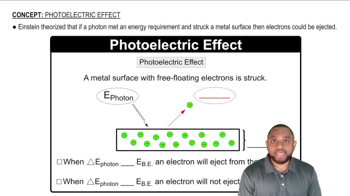
Photoelectric Effect

The photoelectric effect is the phenomenon where electrons are emitted from a material when it absorbs light or electromagnetic radiation. This effect demonstrates the particle nature of light, where photons must have sufficient energy to overcome the work function of the material to eject electrons. The energy of the incoming photons is directly related to their frequency, as described by the equation E = hf, where E is energy, h is Planck's constant, and f is frequency.
Video consigliato:
Percorso guidato
02:31
Photoelectric Effect

Energy-Frequency Relationship

The energy of a photon is directly proportional to its frequency, as given by the equation E = hf. In this equation, h is Planck's constant (approximately 6.626 x 10^-34 J·s). This relationship is crucial for determining whether the energy of incoming photons is sufficient to eject electrons from a material, as seen in the context of the photoelectric effect.
Video consigliato:
Percorso guidato
00:31
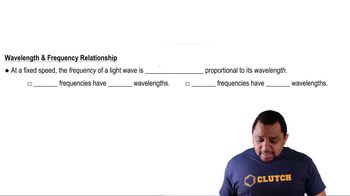
Frequency-Wavelength Relationship

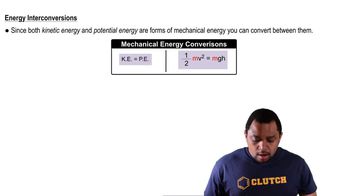
Kinetic Energy of Emitted Electrons

The kinetic energy (KE) of emitted electrons in the photoelectric effect can be calculated using the equation KE = E - W, where E is the energy of the incoming photon and W is the work function of the material. The work function is the minimum energy required to remove an electron from the surface of the material. If the energy of the incoming photon exceeds the work function, the excess energy is converted into the kinetic energy of the emitted electron.
Video consigliato:
Percorso guidato
00:34
Kinetic & Potential Energy