Ch.7 - Periodic Properties of the Elements
Brown - Chemistry: The Central Science 15th Edition
Brown15th EditionChemistry: The Central ScienceISBN: 9780137542970Non è quello che usi tu?Cambia libro di testo
Capitolo 7, Problema 28

For each set of atoms and ions, pick the smallest one.
a. I, I+, I−
b. Be2+, Ca2+, Mg2+
c. Fe, Fe2+, Fe3+

Guida verificata passo dopo passo
1
Step 1: Understand the concept of atomic and ionic size. Generally, cations (positively charged ions) are smaller than their neutral atoms because they lose electrons, reducing electron-electron repulsion and allowing the remaining electrons to be pulled closer to the nucleus. Anions (negatively charged ions) are larger than their neutral atoms because they gain electrons, increasing electron-electron repulsion.
Step 2: Analyze set (a): I, I+, I−. Iodine (I) is a neutral atom. I+ is a cation, which means it has lost an electron, making it smaller than the neutral iodine atom. I− is an anion, which means it has gained an electron, making it larger than the neutral iodine atom.
Step 3: Analyze set (b): Be2+, Ca2+, Mg2+. All are cations with a +2 charge, but they belong to different periods in the periodic table. As you move down a group in the periodic table, the size of the ions increases due to the addition of electron shells. Therefore, Be2+ is the smallest because it is in the second period, while Ca2+ is in the fourth period, and Mg2+ is in the third period.
Step 4: Analyze set (c): Fe, Fe2+, Fe3+. Iron (Fe) is a neutral atom. Fe2+ and Fe3+ are cations, with Fe3+ having lost more electrons than Fe2+. Therefore, Fe3+ is smaller than Fe2+ due to the greater positive charge pulling the remaining electrons closer to the nucleus.
Step 5: Compare the sizes within each set based on the analysis from the previous steps and identify the smallest atom or ion in each set.

Risposta video verificata per un problema simile:

Questa soluzione video è stata consigliata dai nostri tutor come utile per risolvere questo problema.

Concetti chiave

Ecco i concetti essenziali che devi comprendere per rispondere correttamente alla domanda.

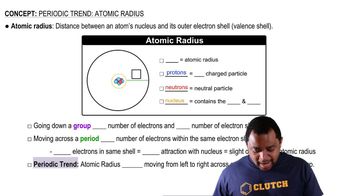
Atomic Radius

The atomic radius is the distance from the nucleus of an atom to the outermost shell of electrons. Generally, atomic size decreases across a period due to increased nuclear charge, which pulls electrons closer to the nucleus. Conversely, atomic size increases down a group as additional electron shells are added, resulting in a larger radius.
Video consigliato:

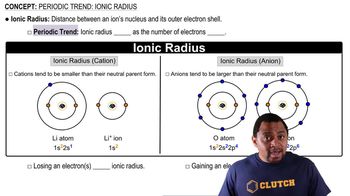
Ionic Radius

Ionic radius refers to the size of an ion in a crystal lattice. Cations (positively charged ions) are typically smaller than their neutral atoms because they lose electrons, reducing electron-electron repulsion and allowing the remaining electrons to be pulled closer to the nucleus. Anions (negatively charged ions) are larger than their neutral atoms due to the addition of electrons, which increases repulsion among electrons.
Video consigliato:

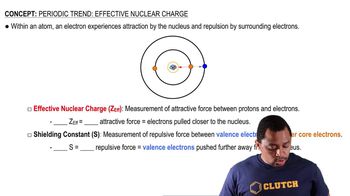
Effective Nuclear Charge (Z_eff)

Effective nuclear charge is the net positive charge experienced by an electron in a multi-electron atom. It accounts for the shielding effect of inner-shell electrons that reduce the full nuclear charge felt by outer-shell electrons. A higher Z_eff leads to a stronger attraction between the nucleus and the outer electrons, resulting in a smaller atomic or ionic size.
Video consigliato:
Percorso guidato
01:51
Effective Nuclear Charge