

Ch.7 - Periodic Properties of the Elements
Brown - Chemistry: The Central Science 15th Edition
Brown15th EditionChemistry: The Central ScienceISBN: 9780137542970Non è quello che usi tu?Cambia libro di testo
Capitolo 7, Problema 20b

With the exception of helium, the noble gases condense to form solids when they are cooled sufficiently. At temperatures below 83 K, argon forms a close-packed solid whose structure is shown below. (b) Is this value larger or smaller than the bonding atomic radius estimated for argon in Figure 7.7?

Guida verificata passo dopo passo
1
Identify the type of solid structure argon forms at temperatures below 83 K, which is a close-packed solid.
Understand that in a close-packed structure, atoms are arranged in a way that maximizes the number of nearest neighbors, typically forming either a face-centered cubic (FCC) or hexagonal close-packed (HCP) structure.
Recognize that the atomic radius in a close-packed structure can be related to the distance between the centers of adjacent atoms, which is often referred to as the bonding atomic radius.
Refer to Figure 7.7 to find the estimated bonding atomic radius for argon, which is typically given in picometers (pm).
Compare the calculated or given atomic radius from the close-packed structure to the bonding atomic radius from Figure 7.7 to determine if it is larger or smaller.

Risposta video verificata per un problema simile:

Questa soluzione video è stata consigliata dai nostri tutor come utile per risolvere questo problema.
Durata del video:
1m

Concetti chiave

Ecco i concetti essenziali che devi comprendere per rispondere correttamente alla domanda.

Noble Gases

Noble gases are a group of elements in Group 18 of the periodic table, known for their lack of reactivity due to having a full valence shell of electrons. They include helium, neon, argon, krypton, xenon, and radon. Understanding their unique properties, such as low boiling points and the ability to form solids at low temperatures, is essential for analyzing their behavior in different states of matter.
Video consigliato:
Percorso guidato
00:44
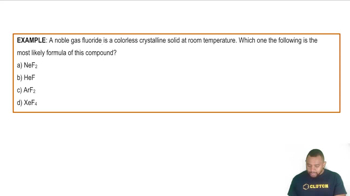
Noble Gas Compounds Example

Bonding Atomic Radius

The bonding atomic radius is a measure of the size of an atom that is bonded to another atom, typically defined as half the distance between the nuclei of two bonded atoms. This concept is crucial for understanding how atoms interact and bond with each other, influencing the physical properties of substances, including their state at various temperatures.
Video consigliato:

Phase Changes and Solid Structure

Phase changes refer to the transitions between solid, liquid, and gas states of matter, which occur due to changes in temperature and pressure. The solid structure of argon at low temperatures, such as below 83 K, involves close-packed arrangements of atoms, which affects its physical properties. Understanding these concepts helps in comparing the solid state of argon with its atomic radius and other characteristics.
Video consigliato:
Percorso guidato
01:46
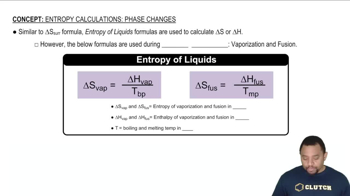
Entropy in Phase Changes
Pratica correlata
Domanda del libro di testo

With the exception of helium, the noble gases condense to form solids when they are cooled sufficiently. At temperatures below 83 K, argon forms a close-packed solid whose structure is shown below. (c) Based on this comparison would you say that the atoms are held together by chemical bonds in solid argon?

601
views
Domanda del libro di testo

Which will experience the greater effective nuclear charge, the electrons in the 𝑛=3 shell in Ar or the 𝑛=3 shell in Kr? Which is more likely to be closer to the nucleus?

3
views
Domanda del libro di testo

Tungsten has the highest melting point of any metal in the periodic table: 3422°C. The distance between the centers of W atoms in tungsten metal is 2.74 Å. c. If you put tungsten metal under high pressure, predict what would happen to the distance between W atoms.

2
views
Domanda del libro di testo

Tungsten has the highest melting point of any metal in the periodic table: 3422°C. The distance between the centers of W atoms in tungsten metal is 2.74 Å. a. What is the atomic radius of a tungsten atom in this environment? (This radius is called the metallic radius.)

2
views
Domanda del libro di testo

Detailed calculations show that the value of Zeff for the outermost electrons in Si and Cl atoms is 4.29+ and 6.12+, respectively. (a) What value do you estimate for Zeff experienced by the outermost electron in both Si and Cl by assuming core electrons contribute 1.00 and valence electrons contribute 0.00 to the screening constant?

4097
views
Domanda del libro di testo

Arrange the following atoms in order of increasing effective nuclear charge experienced by the electrons in the 𝑛=3 electron shell: K, Mg, P, Rh, Ti.

2
views