Ch.9 - Molecular Geometry and Bonding Theories
Brown - Chemistry: The Central Science 15th Edition
Brown15th EditionChemistry: The Central ScienceISBN: 9780137542970Non è quello che usi tu?Cambia libro di testo
Capitolo 9, Problema 40a

a. Consider the AF3 molecules in Exercise 9.27. Which of these will have a nonzero dipole moment?

Guida verificata passo dopo passo
1
Identify the molecular geometry of the AF3 molecules. For example, if A is a central atom and F is a halogen, consider the possible geometries such as trigonal planar or trigonal pyramidal.
Determine the electronegativity difference between the central atom A and the fluorine atoms. Fluorine is highly electronegative, which will influence the dipole moment.
Analyze the symmetry of the molecule. A symmetric molecule (like trigonal planar) may have dipoles that cancel out, resulting in a zero dipole moment.
Consider the presence of lone pairs on the central atom. Lone pairs can affect the geometry, making the molecule asymmetric and potentially resulting in a nonzero dipole moment.
Conclude which AF3 molecules have a nonzero dipole moment based on their geometry and symmetry. Molecules with asymmetrical shapes or lone pairs on the central atom are likely to have a nonzero dipole moment.

Risposta video verificata per un problema simile:

Questa soluzione video è stata consigliata dai nostri tutor come utile per risolvere questo problema.
Durata del video:
4m

Concetti chiave

Ecco i concetti essenziali che devi comprendere per rispondere correttamente alla domanda.

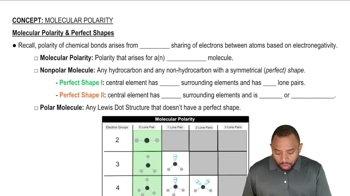
Molecular Polarity

Molecular polarity refers to the distribution of electrical charge across a molecule. A molecule is polar if it has a net dipole moment, which occurs when there is an uneven distribution of electron density due to differences in electronegativity between atoms. This results in one end of the molecule being partially positive and the other end being partially negative.
Video consigliato:
Percorso guidato
02:38
Molecular Polarity

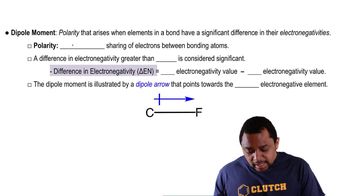
Dipole Moment

The dipole moment is a vector quantity that measures the separation of positive and negative charges in a molecule. It is calculated as the product of the charge and the distance between the charges. A nonzero dipole moment indicates that the molecule has a polar character, while a zero dipole moment suggests that the molecule is nonpolar, often due to symmetrical charge distribution.
Video consigliato:

Symmetry in Molecules

Symmetry plays a crucial role in determining the polarity of a molecule. Molecules with high symmetry, such as those with identical substituents arranged evenly around a central atom, often exhibit nonpolar characteristics because the dipole moments cancel each other out. Conversely, asymmetrical molecules are more likely to have a nonzero dipole moment, leading to polarity.
Video consigliato:
Percorso guidato
02:38
Heteronuclear Diatomic Molecules