Draw sketches illustrating the overlap between the following orbitals on two atoms: (a) the 2s orbital on each atom
Ch.9 - Molecular Geometry and Bonding Theories

Brown15th EditionChemistry: The Central ScienceISBN: 9780137542970Non è quello che usi tu?Cambia libro di testo
Capitolo 9, Problema 43b
Dichloroethylene (C2H2Cl2) has three forms (isomers), each of which is a different substance. (b) Which of these isomers has a zero dipole moment?
Guida verificata passo dopo passo1
Understand that dichloroethylene (C2H2Cl2) has three isomers: 1,1-dichloroethylene, cis-1,2-dichloroethylene, and trans-1,2-dichloroethylene.
Recall that a molecule's dipole moment is determined by the vector sum of the individual bond dipoles. A zero dipole moment means the bond dipoles cancel each other out.
Visualize or draw the structures of the three isomers: 1,1-dichloroethylene has both Cl atoms on the same carbon, cis-1,2-dichloroethylene has Cl atoms on adjacent carbons on the same side, and trans-1,2-dichloroethylene has Cl atoms on adjacent carbons on opposite sides.
Analyze the symmetry of each isomer: trans-1,2-dichloroethylene is symmetrical, which allows the dipoles to cancel out, resulting in a zero dipole moment.
Conclude that trans-1,2-dichloroethylene is the isomer with a zero dipole moment due to its symmetrical structure.

Risposta video verificata per un problema simile:
Questa soluzione video è stata consigliata dai nostri tutor come utile per risolvere questo problema.
Durata del video:
3mConcetti chiave
Ecco i concetti essenziali che devi comprendere per rispondere correttamente alla domanda.
Isomerism
Isomerism refers to the phenomenon where two or more compounds have the same molecular formula but different structural arrangements or spatial orientations. In the case of dichloroethylene (C2H2Cl2), the isomers can differ in the position of the chlorine atoms or the arrangement of the carbon-carbon double bond, leading to distinct chemical and physical properties.
Video consigliato:
Percorso guidato
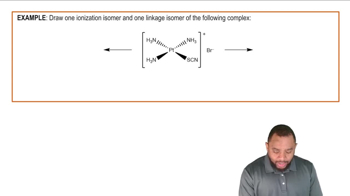
Isomerism in Coordination Complexes Example
Dipole Moment
The dipole moment is a measure of the separation of positive and negative charges in a molecule, indicating its polarity. A molecule with a dipole moment has an uneven distribution of electron density, resulting in a positive and a negative end. Molecules with symmetrical structures can have a zero dipole moment, as the individual bond dipoles cancel each other out.
Video consigliato:
Percorso guidato
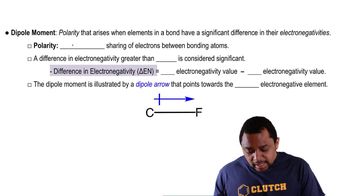
Dipole Moment
Molecular Symmetry
Molecular symmetry plays a crucial role in determining the dipole moment of a molecule. Symmetrical molecules, such as the trans isomer of dichloroethylene, can have their dipole moments cancel out due to equal and opposite charge distributions, resulting in a net dipole moment of zero. Understanding the symmetry of a molecule helps predict its physical properties, including polarity.
Video consigliato:
Percorso guidato
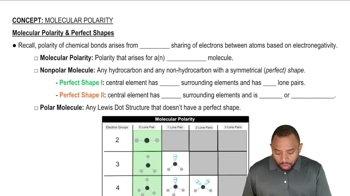
Molecular Polarity
Pratica correlata
Domanda del libro di testo
589
views
1
rank
Domanda del libro di testo
Predict whether each of the following molecules is polar or nonpolar: (a) IF, (b) CS2, (c) SO3, (d) PCl3, (e) SF6, (f) IF5.
1680
views
Domanda del libro di testo
a. Consider the AF3 molecules in Exercise 9.27. Which of these will have a nonzero dipole moment?
2
views
Domanda del libro di testo
Predict whether each of the following molecules is polar or nonpolar: (a) CCl4, (b) NH3, (c) SF4, (d) XeF4, (e) CH3Br, (f) GaH3.
1060
views
Domanda del libro di testo
Dichlorobenzene, C6H4Cl2, exists in three forms (isomers) called ortho, meta, and para:
Which of these has a nonzero dipole moment?
3
views
Domanda del libro di testo
Dichloroethylene (C2H2Cl2) has three forms (isomers), each of which is a different substance. (c) How many isomeric forms can chloroethylene, C2H3Cl, have? Would they be expected to have dipole moments?
2
views