
Ch.9 - Molecular Geometry and Bonding Theories
Brown - Chemistry: The Central Science 15th Edition
Brown15th EditionChemistry: The Central ScienceISBN: 9780137542970Non è quello che usi tu?Cambia libro di testo
Capitolo 9, Problema 86a

An AB3 molecule is described as having a trigonal-bipyramidal electron-domain geometry. a. How many nonbonding domains are on atom A?

Guida verificata passo dopo passo
1
insert step 1> Identify the electron-domain geometry of the molecule. In this case, it is given as trigonal-bipyramidal.
insert step 2> Understand that a trigonal-bipyramidal geometry involves five electron domains around the central atom.
insert step 3> Recognize that the molecule is described as AB3, meaning there are three bonding domains (B atoms) around the central atom A.
insert step 4> Calculate the number of nonbonding domains by subtracting the number of bonding domains from the total number of electron domains: 5 (total domains) - 3 (bonding domains) = 2 nonbonding domains.
insert step 5> Conclude that there are 2 nonbonding domains on atom A in this AB3 molecule with a trigonal-bipyramidal electron-domain geometry.

Risposta video verificata per un problema simile:

Questa soluzione video è stata consigliata dai nostri tutor come utile per risolvere questo problema.
Durata del video:
33s

Concetti chiave

Ecco i concetti essenziali che devi comprendere per rispondere correttamente alla domanda.

Trigonal-Bipyramidal Geometry

Trigonal-bipyramidal geometry occurs when a central atom is surrounded by five electron domains, which can be bonding or nonbonding. In this arrangement, three domains are positioned in a plane at 120-degree angles, while the other two are above and below this plane, forming 90-degree angles with the equatorial domains.
Video consigliato:
Percorso guidato
01:16
Trigonal Bipyramidal Example

Electron Domains

Electron domains refer to regions around a central atom where electrons are likely to be found. These can include bonding pairs (shared between atoms) and lone pairs (nonbonding). The number of electron domains determines the molecular geometry and influences the angles between bonds.
Video consigliato:
Percorso guidato
04:44
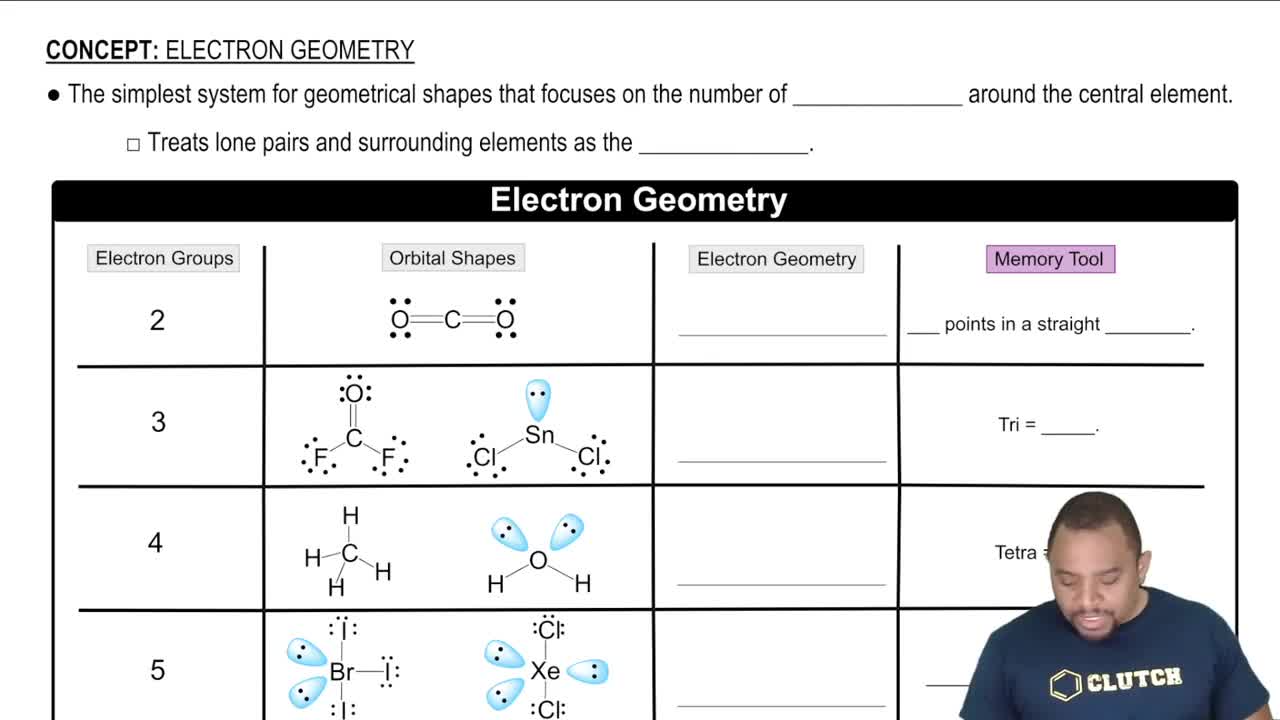
Electron Geometry

Nonbonding Domains

Nonbonding domains, or lone pairs, are pairs of valence electrons that are not involved in bonding with other atoms. In the context of molecular geometry, these domains can affect the shape and angles of the molecule, as they occupy space and repel bonding pairs, leading to adjustments in the overall geometry.
Video consigliato:
Percorso guidato
00:40
Lewis Dot Structures: Neutral Compounds Example 1
Pratica correlata
Domanda del libro di testo

The iodine bromide molecule, IBr, is an interhalogen compound. Assume that the molecular orbitals of IBr are analogous to the homonuclear diatomic molecule F2. (c) One of the valence MOs of IBr is sketched here. Determine whether each of the following statements about this orbital is true: i. This is an antibonding orbital. ii. The larger contribution is from the I atom. iii. The energy of the molecular orbital is closer in energy to the valence atomic orbitals of Br than to those of I.

4
views
1
rank
Domanda del libro di testo

Fill in the blank spaces in the following chart. If the molecule column is blank, find an example that fulfills the conditions of the rest of the row. Molecule Electron-Domain Hybridization Dipole Geometry of Central Atom Moment? Yes or No CO2 sp3 Yes sp3 No Trigonal planar No SF4 Octahedral No sp2 Yes Trigonal bipyramidal No XeF2

582
views
Domanda del libro di testo

The iodine bromide molecule, IBr, is an interhalogen compound. Assume that the molecular orbitals of IBr are analogous to the homonuclear diatomic molecule F2. (a) Which valence atomic orbitals of I and of Br are used to construct the MOs of IBr?

843
views
Domanda del libro di testo

An AB3 molecule is described as having a trigonal-bipyramidal electron-domain geometry b. Based on the information given, which of the following is the molecular geometry of the molecule:

i. trigonal planar

ii. trigonal pyramidal

iii. T-shaped or

iv. tetrahedral?

3
views
Domanda del libro di testo

Assume that the MOs of diatomics from the third row of the periodic table, such as P2, are analogous to those from the second row.

c. For the P2 molecule, how many electrons occupy the MO in the figure?

2
views