Ch.9 - Molecular Geometry and Bonding Theories
Brown - Chemistry: The Central Science 15th Edition
Brown15th EditionChemistry: The Central ScienceISBN: 9780137542970Non è quello che usi tu?Cambia libro di testo
Capitolo 9, Problema 84c

The iodine bromide molecule, IBr, is an interhalogen compound. Assume that the molecular orbitals of IBr are analogous to the homonuclear diatomic molecule F2. (c) One of the valence MOs of IBr is sketched here. Determine whether each of the following statements about this orbital is true: i. This is an antibonding orbital. ii. The larger contribution is from the I atom. iii. The energy of the molecular orbital is closer in energy to the valence atomic orbitals of Br than to those of I.

Guida verificata passo dopo passo
1
Determine the type of molecular orbital: Antibonding orbitals are typically denoted with an asterisk (*). Check if the given molecular orbital has this notation.
Consider the atomic sizes and electronegativities: Iodine (I) is larger and less electronegative than bromine (Br). Larger atoms often contribute more to the molecular orbitals due to their larger atomic orbitals.
Compare the energies of the atomic orbitals: The energy of a molecular orbital is closer to the atomic orbital of the more electronegative atom. Since Br is more electronegative than I, its atomic orbitals are lower in energy.
Analyze the molecular orbital diagram: In a heteronuclear diatomic molecule like IBr, the molecular orbitals are not symmetrically distributed. The more electronegative atom (Br) will have a greater influence on the bonding and antibonding orbitals.
Evaluate the statements based on the above analysis: Use the information about antibonding characteristics, atomic contributions, and energy levels to assess the truth of each statement.

Risposta video verificata per un problema simile:

Questa soluzione video è stata consigliata dai nostri tutor come utile per risolvere questo problema.
Durata del video:
1m

Concetti chiave

Ecco i concetti essenziali che devi comprendere per rispondere correttamente alla domanda.

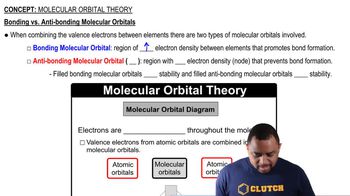
Molecular Orbitals

Molecular orbitals (MOs) are formed by the linear combination of atomic orbitals (LCAO) from the constituent atoms in a molecule. They can be classified as bonding or antibonding orbitals, where bonding orbitals stabilize the molecule and antibonding orbitals destabilize it. Understanding the nature of these orbitals is crucial for predicting the stability and reactivity of molecules.
Video consigliato:
Percorso guidato
03:06
Molecular Orbital Theory

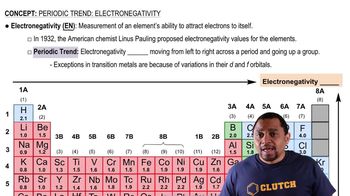
Electronegativity and Atomic Contributions

Electronegativity refers to the tendency of an atom to attract electrons in a bond. In interhalogen compounds like IBr, the contributions of each atom to the molecular orbitals depend on their electronegativities. Since iodine (I) is less electronegative than bromine (Br), the molecular orbital may have a larger contribution from the iodine atom, affecting the overall bonding characteristics.
Video consigliato:
Percorso guidato
02:10
Electronegativity Trends

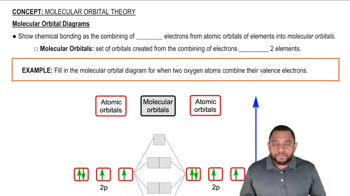
Energy Levels of Atomic and Molecular Orbitals

The energy levels of molecular orbitals are influenced by the energy levels of the atomic orbitals from which they are derived. In IBr, the energy of the molecular orbitals can be compared to the valence atomic orbitals of iodine and bromine. Typically, the energy of a molecular orbital will be closer to that of the atomic orbital of the more electronegative atom, which in this case is bromine.
Video consigliato:
Percorso guidato
04:12
Molecular Orbital Diagram
Pratica correlata
Domanda del libro di testo

An AB3 molecule is described as having a trigonal-bipyramidal electron-domain geometry. a. How many nonbonding domains are on atom A?

2
views

Domanda del libro di testo

Fill in the blank spaces in the following chart. If the molecule column is blank, find an example that fulfills the conditions of the rest of the row. Molecule Electron-Domain Hybridization Dipole Geometry of Central Atom Moment? Yes or No CO2 sp3 Yes sp3 No Trigonal planar No SF4 Octahedral No sp2 Yes Trigonal bipyramidal No XeF2

582
views
Domanda del libro di testo

Assume that the MOs of diatomics from the third row of the periodic table, such as P2, are analogous to those from the second row.

a. Which valence atomic orbitals of P are used to construct the MOs of P2?

4
views
Domanda del libro di testo

The iodine bromide molecule, IBr, is an interhalogen compound. Assume that the molecular orbitals of IBr are analogous to the homonuclear diatomic molecule F2. (a) Which valence atomic orbitals of I and of Br are used to construct the MOs of IBr?

843
views
Domanda del libro di testo

An AB3 molecule is described as having a trigonal-bipyramidal electron-domain geometry b. Based on the information given, which of the following is the molecular geometry of the molecule:

i. trigonal planar

ii. trigonal pyramidal

iii. T-shaped or

iv. tetrahedral?

3
views
Domanda del libro di testo

Assume that the MOs of diatomics from the third row of the periodic table, such as P2, are analogous to those from the second row.

c. For the P2 molecule, how many electrons occupy the MO in the figure?

2
views