Ch.9 - Molecular Geometry and Bonding Theories
Brown - Chemistry: The Central Science 15th Edition
Brown15th EditionChemistry: The Central ScienceISBN: 9780137542970Non è quello che usi tu?Cambia libro di testo
Capitolo 9, Problema 19b

(b) An AB4 molecule has two lone pairs of electrons on the A atom (in addition to the four B atoms). What is the electron-domain geometry around the A atom?

Guida verificata passo dopo passo
1
Identify the total number of electron domains around the central atom A. This includes both bonding pairs (from the B atoms) and lone pairs on A.
Count the bonding pairs from the four B atoms and the two lone pairs on A. This gives a total of six electron domains around atom A.
Recall that the arrangement of electron domains is determined by minimizing repulsions between them, according to VSEPR theory.
Use the VSEPR model to determine the geometry that accommodates six electron domains. This is typically an octahedral arrangement.
Conclude that the electron-domain geometry around the A atom, considering both bonding pairs and lone pairs, is octahedral.

Risposta video verificata per un problema simile:

Questa soluzione video è stata consigliata dai nostri tutor come utile per risolvere questo problema.
Durata del video:
6m

Concetti chiave

Ecco i concetti essenziali che devi comprendere per rispondere correttamente alla domanda.

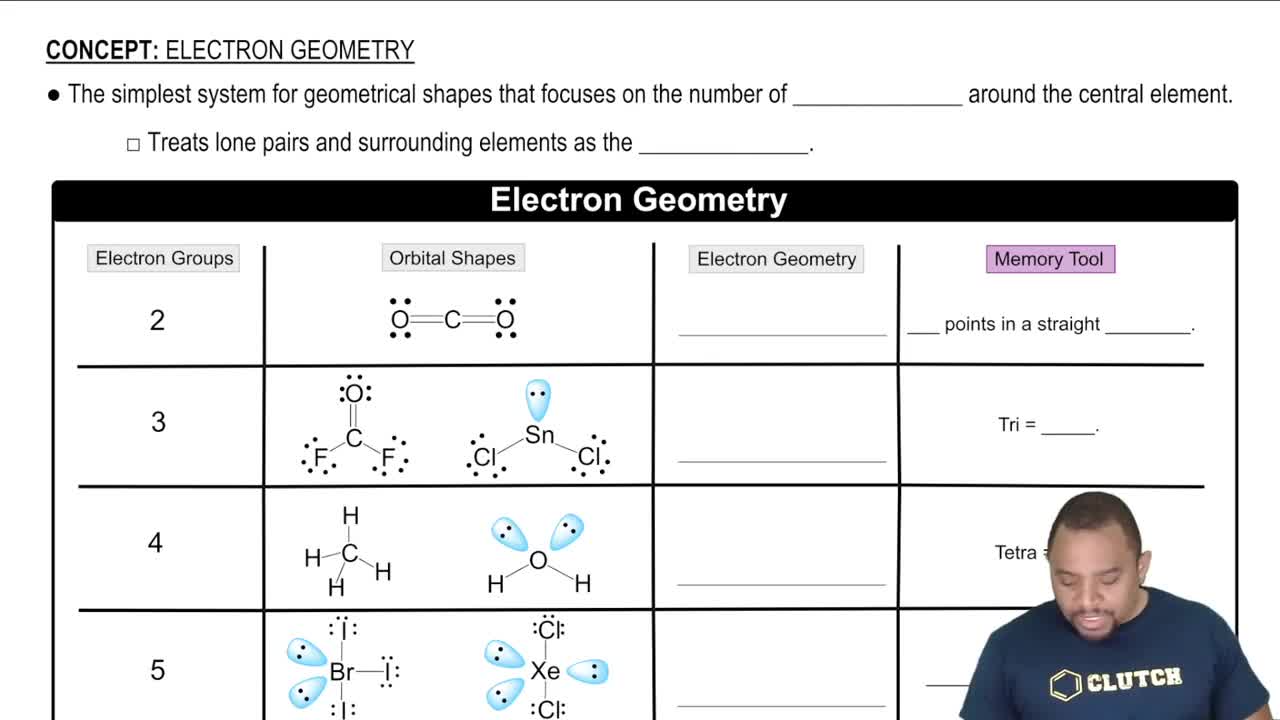
Electron-Domain Geometry

Electron-domain geometry refers to the spatial arrangement of all electron domains (bonding and lone pairs) around a central atom in a molecule. It helps predict the shape of the molecule based on the number of electron pairs, whether they are involved in bonding or are lone pairs. The geometry is determined using the VSEPR (Valence Shell Electron Pair Repulsion) theory, which states that electron pairs will arrange themselves to minimize repulsion.
Video consigliato:
Percorso guidato
04:44
Electron Geometry

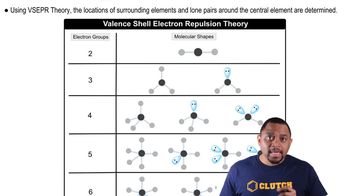
VSEPR Theory

VSEPR theory is a model used to predict the geometry of individual molecules based on the number of electron pairs surrounding their central atoms. According to this theory, electron pairs, including lone pairs and bonding pairs, repel each other and will arrange themselves in a way that maximizes the distance between them. This results in specific molecular shapes, such as tetrahedral, trigonal bipyramidal, or octahedral, depending on the number of electron domains.
Video consigliato:
Percorso guidato
02:13
Molecular Shapes and VSEPR

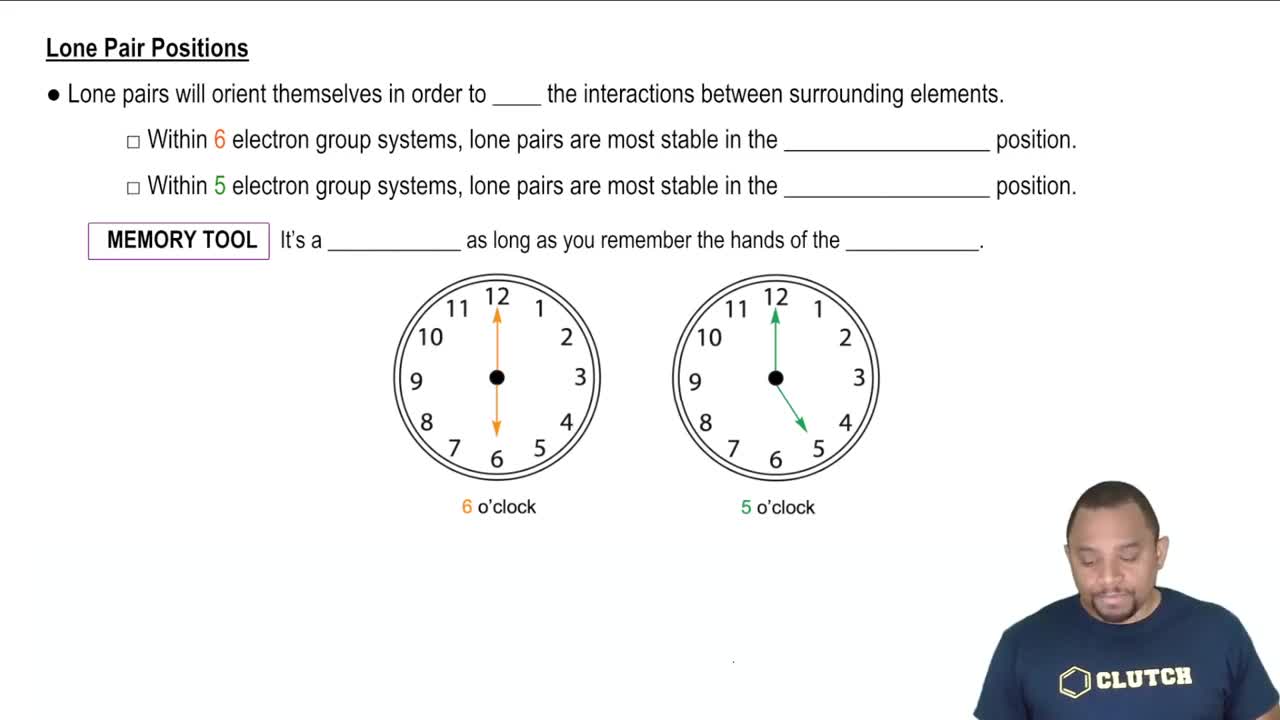
Lone Pairs and Their Influence

Lone pairs are pairs of valence electrons that are not involved in bonding and are localized on a single atom. They occupy space and exert repulsive forces on other electron domains, influencing the overall geometry of the molecule. In the case of the AB4 molecule with two lone pairs on the A atom, these lone pairs will affect the arrangement of the bonding pairs, leading to a specific electron-domain geometry that differs from that of a molecule with only bonding pairs.
Video consigliato:
Percorso guidato
01:33
Lone Pair Positions