Ch.9 - Molecular Geometry and Bonding Theories
Brown - Chemistry: The Central Science 15th Edition
Brown15th EditionChemistry: The Central ScienceISBN: 9780137542970Non è quello che usi tu?Cambia libro di testo
Capitolo 9, Problema 20

Would you expect the nonbonding electron-pair domain in NH3 to be greater or less in size than the corresponding one in PH3?

Guida verificata passo dopo passo
1
Identify the central atoms in NH3 and PH3, which are nitrogen (N) and phosphorus (P), respectively.
Recall that nonbonding electron pairs, also known as lone pairs, occupy more space than bonding pairs due to their higher electron density and lack of shared attraction to another nucleus.
Consider the position of nitrogen and phosphorus in the periodic table. Nitrogen is in the second period, while phosphorus is in the third period.
Understand that atoms in higher periods have larger atomic radii and more diffuse electron clouds, which can affect the size of the electron-pair domains.
Conclude that the nonbonding electron-pair domain in NH3 is expected to be smaller than in PH3 because nitrogen's lone pairs are closer to the nucleus and more compact compared to the more diffuse lone pairs in phosphorus.

Risposta video verificata per un problema simile:

Questa soluzione video è stata consigliata dai nostri tutor come utile per risolvere questo problema.
Durata del video:
3m

Concetti chiave

Ecco i concetti essenziali che devi comprendere per rispondere correttamente alla domanda.

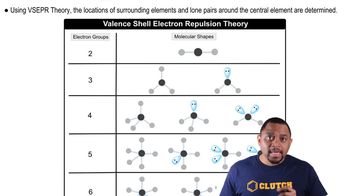
VSEPR Theory

Valence Shell Electron Pair Repulsion (VSEPR) Theory is used to predict the geometry of molecules based on the repulsion between electron pairs. Nonbonding electron pairs, or lone pairs, occupy more space than bonding pairs, influencing the overall shape of the molecule. In NH3 and PH3, the presence of lone pairs affects the bond angles and molecular geometry.
Video consigliato:
Percorso guidato
02:13
Molecular Shapes and VSEPR

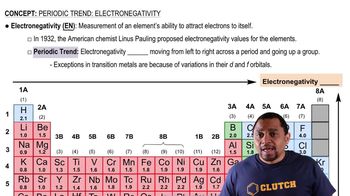
Atomic Size and Electronegativity

Atomic size generally increases down a group in the periodic table due to the addition of electron shells. In NH3, nitrogen is smaller and more electronegative than phosphorus in PH3, which affects the size of the nonbonding electron-pair domain. The greater size of the phosphorus atom leads to a larger nonbonding electron-pair domain compared to nitrogen.
Video consigliato:
Percorso guidato
02:10
Electronegativity Trends

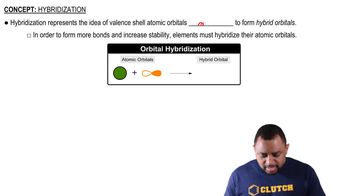
Hybridization

Hybridization is the concept of mixing atomic orbitals to form new hybrid orbitals that can accommodate bonding and lone pairs. In NH3, nitrogen undergoes sp3 hybridization, resulting in a tetrahedral arrangement with one lone pair, while PH3 has less effective hybridization, leading to a different spatial arrangement. This difference in hybridization affects the size and spatial distribution of the nonbonding electron-pair domain.
Video consigliato: