
Ch.9 - Molecular Geometry and Bonding Theories
Brown - Chemistry: The Central Science 15th Edition
Brown15th EditionChemistry: The Central ScienceISBN: 9780137542970Non è quello che usi tu?Cambia libro di testo
Capitolo 9, Problema 81a

Determine the electron configurations for CN+, CN, and CN-. (a) Which species has the strongest C¬N bond?

Guida verificata passo dopo passo
1
Identify the total number of electrons for each species: CN+, CN, and CN-. CN has 13 electrons (6 from C and 7 from N), CN+ has 12 electrons, and CN- has 14 electrons.
Write the electron configuration for each species using molecular orbital theory. For CN, fill the molecular orbitals in the order: \( \sigma_{1s}^2, \sigma^*_{1s}^2, \sigma_{2s}^2, \sigma^*_{2s}^2, \pi_{2p_x}^2 = \pi_{2p_y}^2, \sigma_{2p_z}^2 \).
Adjust the electron configuration for CN+ by removing one electron from the highest occupied molecular orbital (HOMO) of CN, and for CN- by adding one electron to the HOMO of CN.
Determine the bond order for each species using the formula: \( \text{Bond Order} = \frac{1}{2} (\text{Number of bonding electrons} - \text{Number of antibonding electrons}) \).
Compare the bond orders of CN+, CN, and CN- to determine which species has the strongest C-N bond. The species with the highest bond order will have the strongest bond.

Risposta video verificata per un problema simile:

Questa soluzione video è stata consigliata dai nostri tutor come utile per risolvere questo problema.
Durata del video:
6m

Concetti chiave

Ecco i concetti essenziali che devi comprendere per rispondere correttamente alla domanda.

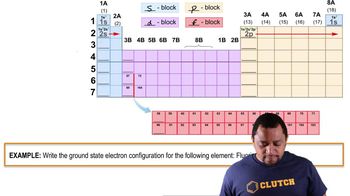
Electron Configuration

Electron configuration describes the distribution of electrons in an atom or ion across various energy levels and orbitals. It is represented using a notation that indicates the number of electrons in each subshell, such as 1s² 2s² 2p⁶. Understanding electron configurations is crucial for predicting chemical behavior, including bond formation and stability.
Video consigliato:
Percorso guidato
01:33
Electron Configuration Example

Bond Order

Bond order is a measure of the number of chemical bonds between a pair of atoms. It is calculated as the difference between the number of bonding and antibonding electrons divided by two. A higher bond order typically indicates a stronger bond, as it reflects greater electron density between the nuclei of the bonded atoms.
Video consigliato:
Percorso guidato
00:36
Average Bond Order

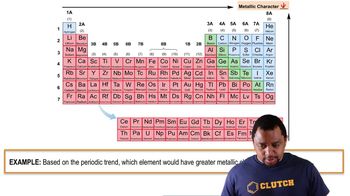
Ionic and Covalent Character

Ionic and covalent character refers to the nature of the bond between atoms, influenced by their electronegativities. In a covalent bond, electrons are shared, while in an ionic bond, electrons are transferred. The balance of these characters affects bond strength; for example, a more covalent bond often results in a stronger interaction between atoms, impacting the overall stability of the molecule.
Video consigliato:
Percorso guidato
00:56
Metallic Character Example