
Ch.9 - Molecular Geometry and Bonding Theories
Brown - Chemistry: The Central Science 15th Edition
Brown15th EditionChemistry: The Central ScienceISBN: 9780137542970Non è quello che usi tu?Cambia libro di testo
Capitolo 9, Problema 80b

If we assume that the energy-level diagrams for homonuclear diatomic molecules shown in Figure 9.43 can be applied to heteronuclear diatomic molecules and ions, predict the bond order and magnetic behavior of b. NO–

Guida verificata passo dopo passo
1
Identify the total number of electrons in the molecule NO⁻. Nitrogen (N) has 7 electrons, oxygen (O) has 8 electrons, and the negative charge adds 1 more electron, totaling 16 electrons.
Use the molecular orbital (MO) theory to distribute these 16 electrons in the molecular orbitals. For NO⁻, the order of filling is: \( \sigma_{1s}^2, \sigma^*_{1s}^2, \sigma_{2s}^2, \sigma^*_{2s}^2, \sigma_{2p_z}^2, \pi_{2p_x}^2 = \pi_{2p_y}^2, \pi^*_{2p_x}^2 = \pi^*_{2p_y}^1 \).
Calculate the bond order using the formula: \( \text{Bond Order} = \frac{1}{2} (\text{Number of bonding electrons} - \text{Number of antibonding electrons}) \).
Determine the magnetic behavior by checking for unpaired electrons. If there are unpaired electrons, the molecule is paramagnetic; if all electrons are paired, it is diamagnetic.
Conclude the bond order and magnetic behavior based on the calculations and observations from the previous steps.

Risposta video verificata per un problema simile:

Questa soluzione video è stata consigliata dai nostri tutor come utile per risolvere questo problema.
Durata del video:
5m

Concetti chiave

Ecco i concetti essenziali che devi comprendere per rispondere correttamente alla domanda.

Bond Order

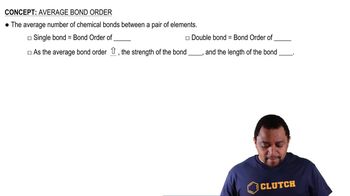
Bond order is a measure of the number of chemical bonds between a pair of atoms. It is calculated as the difference between the number of bonding and antibonding electrons divided by two. A higher bond order indicates a stronger bond and greater stability of the molecule. For example, a bond order of 1 corresponds to a single bond, while a bond order of 2 corresponds to a double bond.
Video consigliato:
Percorso guidato
00:36
Average Bond Order

Magnetic Behavior

Magnetic behavior in molecules is determined by the presence of unpaired electrons. Molecules with unpaired electrons exhibit paramagnetism, meaning they are attracted to magnetic fields, while those with all electrons paired are diamagnetic and are repelled by magnetic fields. Understanding the electron configuration and the arrangement of electrons in molecular orbitals is crucial for predicting a molecule's magnetic properties.
Video consigliato:
Percorso guidato
00:59
Magnetic Quantum Example

Molecular Orbital Theory

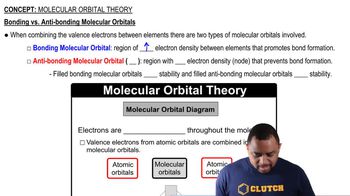
Molecular Orbital Theory describes the behavior of electrons in molecules by considering the combination of atomic orbitals to form molecular orbitals. These orbitals can be bonding, antibonding, or non-bonding, and they help explain the stability, bond order, and magnetic properties of molecules. This theory is particularly useful for analyzing diatomic molecules, including both homonuclear and heteronuclear types.
Video consigliato:
Percorso guidato
03:06
Molecular Orbital Theory