
Ch.9 - Molecular Geometry and Bonding Theories
Brown - Chemistry: The Central Science 15th Edition
Brown15th EditionChemistry: The Central ScienceISBN: 9780137542970Non è quello che usi tu?Cambia libro di testo
Capitolo 9, Problema 98a

The molecule C4H5N has the connectivity shown here. a. After the Lewis structure for the molecule is completed, how many 𝜎 and how many 𝜋 bonds are there in this molecule?

Guida verificata passo dopo passo
1
Step 1: Draw the Lewis structure for C4H5N. Start by arranging the atoms according to the given connectivity.
Step 2: Count the total number of valence electrons available. Carbon (C) has 4 valence electrons, hydrogen (H) has 1, and nitrogen (N) has 5.
Step 3: Distribute the electrons to form bonds between the atoms, ensuring each atom satisfies the octet rule where applicable.
Step 4: Identify the types of bonds formed. A single bond is a sigma (𝜎) bond, while a double bond consists of one sigma (𝜎) and one pi (𝜋) bond.
Step 5: Count the total number of sigma (𝜎) and pi (𝜋) bonds in the completed Lewis structure.

Risposta video verificata per un problema simile:

Questa soluzione video è stata consigliata dai nostri tutor come utile per risolvere questo problema.
Durata del video:
2m

Concetti chiave

Ecco i concetti essenziali che devi comprendere per rispondere correttamente alla domanda.

Lewis Structures

Lewis structures are diagrams that represent the bonding between atoms in a molecule and the lone pairs of electrons that may exist. They help visualize the arrangement of electrons and the connectivity of atoms, allowing chemists to predict molecular geometry and reactivity. Understanding how to draw and interpret Lewis structures is essential for identifying the types of bonds present in a molecule.
Video consigliato:
Percorso guidato
04:28
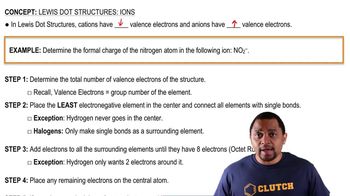
Lewis Dot Structures: Ions

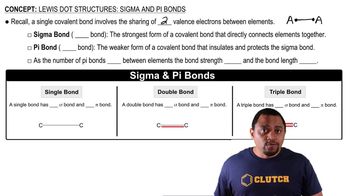
Sigma (𝜎) and Pi (𝜋) Bonds

Sigma (𝜎) bonds are the first bonds formed between two atoms, created by the head-on overlap of atomic orbitals. Pi (𝜋) bonds, on the other hand, are formed by the side-to-side overlap of p orbitals and are present in double and triple bonds alongside sigma bonds. Recognizing the difference between these bond types is crucial for determining the total number of each in a given molecule.
Video consigliato:
Percorso guidato
03:26
Lewis Dot Structures: Sigma & Pi Bonds

Bond Counting

Bond counting involves identifying and quantifying the different types of bonds in a molecule after constructing its Lewis structure. This process includes counting the number of sigma and pi bonds, which is important for understanding the molecule's stability, reactivity, and overall structure. Accurate bond counting is essential for answering questions related to molecular composition and behavior.
Video consigliato:
Pratica correlata
Domanda del libro di testo

The O—H bond lengths in the water molecule (H2O) are 0.96 Å, and the H—O—H angle is 104.5°. The overall dipole moment of the water molecule is 1.85 D. b. Calculate the magnitude of the bond dipole of the O─H bonds. (Note: You will need to use vector addition to do this.)

2
views
Domanda del libro di testo

Sodium azide is a shock-sensitive compound that releases N2 upon physical impact. The compound is used in automobile airbags. The azide ion is N3-. (a) Draw the Lewis structure of the azide ion that minimizes formal charge (it does not form a triangle). Is it linear or bent?

537
views
Domanda del libro di testo

Sodium azide is a shock-sensitive compound that releases N2 upon physical impact. The compound is used in automobile airbags. The azide ion is N3-. (b) State the hybridization of the central N atom in the azide ion.

720
views
Domanda del libro di testo

a. Predict the electron-domain geometry around the central Xe atom in XeF2, XeF4, and XeF6.

2
views
Domanda del libro di testo

In ozone, O3, the two oxygen atoms on the ends of the molecule are equivalent to one another. (d) How many electrons are delocalized in the p system of ozone?

1548
views
Domanda del libro di testo

Which of the following statements about hybrid orbitals is or are true? a. After an atom undergoes sp hybridization, there is one unhybridized p orbital on the atom, b. Under 𝑠𝑝2 hybridization, the large lobes point to the vertices of an equilateral triangle, and c. The angle between the large lobes of 𝑠𝑝3 hybrids is 109.5°.