
Ch.9 - Molecular Geometry and Bonding Theories
Brown - Chemistry: The Central Science 15th Edition
Brown15th EditionChemistry: The Central ScienceISBN: 9780137542970Non è quello che usi tu?Cambia libro di testo
Capitolo 9, Problema 96

Which of the following statements about hybrid orbitals is or are true? a. After an atom undergoes sp hybridization, there is one unhybridized p orbital on the atom, b. Under 𝑠𝑝2 hybridization, the large lobes point to the vertices of an equilateral triangle, and c. The angle between the large lobes of 𝑠𝑝3 hybrids is 109.5°.

Guida verificata passo dopo passo
1
Identify the type of hybridization mentioned in each statement: sp, sp2, and sp3.
For statement a, recall that sp hybridization involves the mixing of one s orbital and one p orbital, leaving two unhybridized p orbitals.
For statement b, understand that sp2 hybridization involves the mixing of one s orbital and two p orbitals, forming three hybrid orbitals that point towards the vertices of an equilateral triangle.
For statement c, remember that sp3 hybridization involves the mixing of one s orbital and three p orbitals, resulting in four hybrid orbitals with bond angles of 109.5°.
Evaluate each statement based on the understanding of hybridization and determine which are true.

Risposta video verificata per un problema simile:

Questa soluzione video è stata consigliata dai nostri tutor come utile per risolvere questo problema.
Durata del video:
38s

Concetti chiave

Ecco i concetti essenziali che devi comprendere per rispondere correttamente alla domanda.

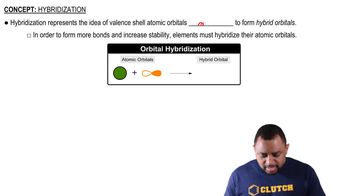
Hybridization

Hybridization is a concept in chemistry that describes the mixing of atomic orbitals to form new hybrid orbitals. These hybrid orbitals have different shapes and energies than the original atomic orbitals, allowing for the formation of covalent bonds in molecules. The type of hybridization (e.g., sp, sp2, sp3) determines the geometry and bond angles of the molecule.
Video consigliato:

Geometry of Hybrid Orbitals

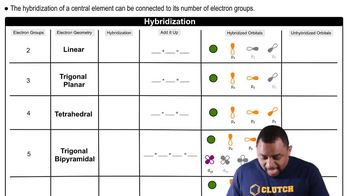
The geometry of hybrid orbitals is determined by the type of hybridization. For example, sp hybridization results in a linear arrangement with a bond angle of 180°, sp2 hybridization leads to a trigonal planar shape with 120° bond angles, and sp3 hybridization results in a tetrahedral geometry with bond angles of approximately 109.5°. Understanding these geometries is crucial for predicting molecular shapes and reactivity.
Video consigliato:
Percorso guidato
03:06
Hybridization and Electron Geometry

Unhybridized Orbitals

Unhybridized orbitals are atomic orbitals that remain unchanged during the hybridization process. For instance, in sp hybridization, one p orbital remains unhybridized, while in sp2 and sp3 hybridizations, the number of unhybridized p orbitals varies. These unhybridized orbitals can participate in pi bonding, influencing the overall bonding and structure of the molecule.
Video consigliato:
Percorso guidato
03:06
Molecular Orbital Theory