
Domanda del libro di testo
In the formate ion, HCO2-, the carbon atom is the central atom with the other three atoms attached to it. (d) How many electrons are in the p system of the ion?
742
views

 Guida verificata passo dopo passo
 00:51
00:51
 01:33
01:33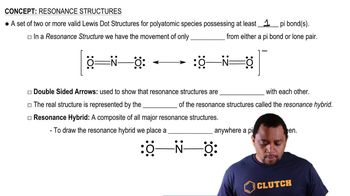 01:42
01:42In the formate ion, HCO2-, the carbon atom is the central atom with the other three atoms attached to it. (d) How many electrons are in the p system of the ion?
Consider the following Lewis structure:
a. Does the Lewis structure depict a neutral molecule or an ion? If it is an ion, what is the charge on the ion?
Consider the H2+ ion. (a) Sketch the molecular orbitals of the ion and draw its energy-level diagram.
Predict the molecular geometry of each of the following molecules: (b) H O C O C O O H
Which of the following statements about molecular orbitals and hybrid orbitals are true?
a. Molecular orbitals and hybrid orbitals are both created by mathematically mixing the wave functions of atomic orbitals.
b. Molecular orbitals are made by combining atomic orbitals from different atoms.
c. Hybrid orbitals and molecular orbitals are different names for the same things.
d. A hybrid orbital can hold more electrons than can a molecular orbital.
Consider the H2+ ion. (b) How many electrons are there in the H2+ ion?