Ch.9 - Molecular Geometry and Bonding Theories
Brown - Chemistry: The Central Science 15th Edition
Brown15th EditionChemistry: The Central ScienceISBN: 9780137542970Non è quello che usi tu?Cambia libro di testo
Capitolo 9, Problema 70

Which of the following statements about molecular orbitals and hybrid orbitals are true?
a. Molecular orbitals and hybrid orbitals are both created by mathematically mixing the wave functions of atomic orbitals.
b. Molecular orbitals are made by combining atomic orbitals from different atoms.
c. Hybrid orbitals and molecular orbitals are different names for the same things.
d. A hybrid orbital can hold more electrons than can a molecular orbital.

Guida verificata passo dopo passo
1
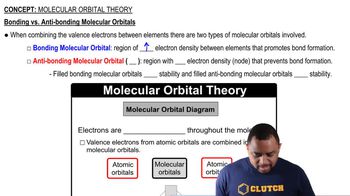
Step 1: Understand the concept of molecular orbitals. Molecular orbitals are formed by the combination of atomic orbitals from different atoms, which can be bonding or antibonding.
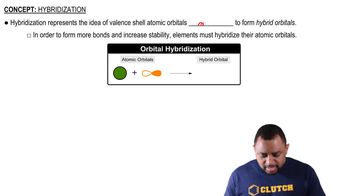
Step 2: Understand the concept of hybrid orbitals. Hybrid orbitals are formed by the mixing of atomic orbitals from the same atom to form new orbitals that are degenerate and oriented in specific directions to form bonds.
Step 3: Evaluate statement a. Both molecular and hybrid orbitals involve the mathematical mixing of atomic orbitals, but they serve different purposes.
Step 4: Evaluate statement b. Molecular orbitals are indeed formed by combining atomic orbitals from different atoms, which is a true statement.
Step 5: Evaluate statements c and d. Hybrid orbitals and molecular orbitals are not the same, and a hybrid orbital does not hold more electrons than a molecular orbital.

Risposta video verificata per un problema simile:

Questa soluzione video è stata consigliata dai nostri tutor come utile per risolvere questo problema.
Durata del video:
1m

Concetti chiave

Ecco i concetti essenziali che devi comprendere per rispondere correttamente alla domanda.

Molecular Orbitals

Molecular orbitals (MOs) are formed by the linear combination of atomic orbitals (LCAO) from different atoms in a molecule. They describe the probability distribution of electrons in a molecule and can be bonding, antibonding, or non-bonding. MOs allow for the understanding of molecular stability and reactivity, as they determine how electrons are shared or distributed between atoms.
Video consigliato:
Percorso guidato
03:06
Molecular Orbital Theory

Hybrid Orbitals

Hybrid orbitals are formed by the mixing of atomic orbitals from a single atom to create new orbitals that are degenerate in energy. This process allows for the formation of bonds with specific geometries, such as sp, sp2, or sp3 hybridization, which correspond to different molecular shapes. Hybrid orbitals are crucial for explaining the bonding in molecules with covalent bonds.
Video consigliato:

Differences Between Molecular and Hybrid Orbitals

Molecular orbitals and hybrid orbitals serve different purposes in molecular chemistry. While molecular orbitals involve the combination of atomic orbitals from different atoms to describe electron distribution in a molecule, hybrid orbitals are concerned with the arrangement of atomic orbitals within a single atom to facilitate bonding. Understanding these distinctions is essential for analyzing molecular structure and bonding behavior.
Video consigliato:
Percorso guidato
03:06
Molecular Orbital Theory