Ch.1 - Chemical Tools: Experimentation & Measurement
McMurry - Chemistry 8th Edition
McMurry8th EditionChemistryISBN: 9781292336145Non è quello che usi tu?Cambia libro di testo
Capitolo 1, Problema 79

Assume that the kinetic energy of a 1400 kg car moving at 115 km/h (Problem 1.78) is converted entirely into heat. How many calories of heat are released, and what amount of water in liters could be heated from 20.0 °C to 50.0 °C by the car's energy? (One calorie raises the temperature of 1 mL of water by 1 °C)

Guida verificata passo dopo passo
1
Convert the speed of the car from km/h to m/s by multiplying by the conversion factor (1000 m/1 km) and dividing by the time conversion factor (3600 s/1 h).
Calculate the kinetic energy (KE) of the car using the formula KE = \(\frac{1}{2}mv^2\), where \(m\) is the mass of the car and \(v\) is its velocity in m/s.
Convert the kinetic energy from joules to calories, knowing that 1 joule is approximately 0.239005736 calories.
Calculate the total amount of heat in calories that would be required to raise the temperature of water from 20.0 °C to 50.0 °C. Use the formula \(Q = mc\Delta T\), where \(m\) is the mass of the water in grams, \(c\) is the specific heat capacity of water (1 cal/g°C), and \(\Delta T\) is the change in temperature.
Determine the volume of water in liters that could be heated using the total calories calculated from the kinetic energy, knowing that 1 mL of water has a mass of 1 gram and there are 1000 mL in a liter.

Risposta video verificata per un problema simile:

Questa soluzione video è stata consigliata dai nostri tutor come utile per risolvere questo problema.
Durata del video:
7m

Concetti chiave

Ecco i concetti essenziali che devi comprendere per rispondere correttamente alla domanda.

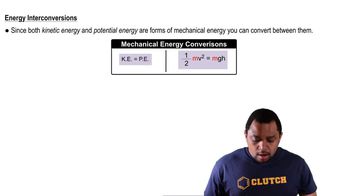
Kinetic Energy

Kinetic energy is the energy an object possesses due to its motion, calculated using the formula KE = 0.5 * m * v², where m is mass and v is velocity. In this scenario, the car's mass is 1400 kg and its speed is converted from km/h to m/s to find the kinetic energy in joules, which will later be converted to calories.
Video consigliato:
Percorso guidato
00:34
Kinetic & Potential Energy

Caloric Conversion

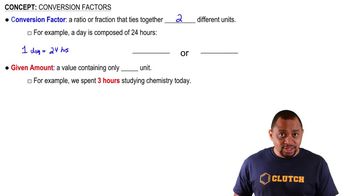
The conversion between joules and calories is essential for this problem. One calorie is defined as the amount of energy needed to raise the temperature of 1 gram of water by 1 °C. Knowing that 1 calorie equals approximately 4.184 joules allows us to convert the kinetic energy calculated into calories to determine how much heat is released.
Video consigliato:
Percorso guidato
01:56
Conversion Factors

Specific Heat Capacity

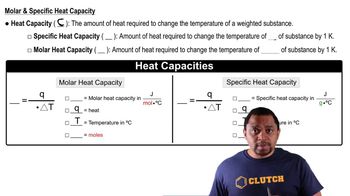
Specific heat capacity is the amount of heat required to raise the temperature of a unit mass of a substance by one degree Celsius. For water, this value is 1 cal/g°C, meaning that to heat water from 20.0 °C to 50.0 °C, we can use the heat energy calculated from the car's kinetic energy to find out how many grams (or liters, since 1 mL of water has a mass of 1 g) can be heated to that temperature.
Video consigliato: