Ch.1 - Chemical Tools: Experimentation & Measurement
McMurry - Chemistry 8th Edition
McMurry8th EditionChemistryISBN: 9781292336145Non è quello che usi tu?Cambia libro di testo
Capitolo 1, Problema 76

The density of chloroform, a widely used organic solvent, is 1.4832 g/mL at 20 °C. How many milliliters would you use if you wanted 112.5 g of chloroform?

Guida verificata passo dopo passo
1
Step 1: Understand the problem. We are given the density of chloroform and the mass we want. We need to find the volume of chloroform that corresponds to the given mass.
Step 2: Recall the formula for density, which is mass divided by volume (d = m/v). We can rearrange this formula to solve for volume (v = m/d).
Step 3: Substitute the given values into the formula. The mass (m) is 112.5 g and the density (d) is 1.4832 g/mL.
Step 4: Perform the division operation to calculate the volume. Remember to keep the units consistent, in this case, the mass is in grams and the density is in grams per milliliter, so the volume will be in milliliters.
Step 5: The result of the division is the volume of chloroform in milliliters that corresponds to the given mass of 112.5 g.

Risposta video verificata per un problema simile:

Questa soluzione video è stata consigliata dai nostri tutor come utile per risolvere questo problema.
Durata del video:
1m

Concetti chiave

Ecco i concetti essenziali che devi comprendere per rispondere correttamente alla domanda.

Density

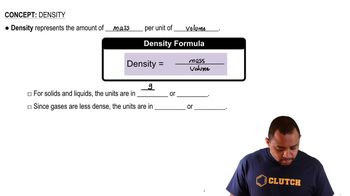
Density is defined as the mass of a substance per unit volume, typically expressed in grams per milliliter (g/mL) for liquids. It is a crucial property that helps determine how much space a given mass of a substance will occupy. In this case, the density of chloroform is 1.4832 g/mL, indicating that each milliliter of chloroform weighs 1.4832 grams.
Video consigliato:
Percorso guidato
01:56
Density Concepts

Mass-Volume Relationship

The mass-volume relationship is a fundamental concept in chemistry that relates the mass of a substance to its volume through its density. This relationship can be expressed with the formula: mass = density × volume. By rearranging this formula, one can calculate the volume needed for a specific mass of a substance, which is essential for solving the given problem regarding chloroform.
Video consigliato:
Percorso guidato
01:09
Relationship of Volume and Moles Example

Unit Conversion

Unit conversion is the process of converting a quantity expressed in one set of units to another set of units. In this context, it is important to ensure that the units of mass (grams) and volume (milliliters) are compatible when using the density to find the required volume of chloroform. Understanding how to convert between different units is essential for accurate calculations in chemistry.
Video consigliato:
Percorso guidato
01:56
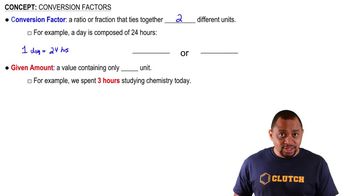
Conversion Factors