Ch.1 - Chemical Tools: Experimentation & Measurement
McMurry - Chemistry 8th Edition
McMurry8th EditionChemistryISBN: 9781292336145Non è quello che usi tu?Cambia libro di testo
Capitolo 1, Problema 46

How many microliters are in 1 L? In 20 mL?

Guida verificata passo dopo passo
1
Understand the conversion factor: 1 liter (L) is equal to 1,000,000 microliters (\(\mu L\)).
To convert from liters to microliters, multiply the number of liters by 1,000,000.
For the first part of the problem, multiply 1 L by 1,000,000 to find the number of microliters in 1 L.
For the second part of the problem, convert milliliters (mL) to microliters (\(\mu L\)). Remember that 1 mL is equal to 1,000 \(\mu L\).
Multiply 20 mL by 1,000 to find the number of microliters in 20 mL.

Risposta video verificata per un problema simile:

Questa soluzione video è stata consigliata dai nostri tutor come utile per risolvere questo problema.
Durata del video:
1m

Concetti chiave

Ecco i concetti essenziali che devi comprendere per rispondere correttamente alla domanda.

Metric System and Units of Measurement

The metric system is a decimal-based system of measurement used globally, where units are based on powers of ten. Understanding the relationships between different metric units, such as liters (L), milliliters (mL), and microliters (µL), is essential for converting between them. For instance, 1 L equals 1,000 mL, and 1 mL equals 1,000 µL.
Video consigliato:
Percorso guidato
02:52
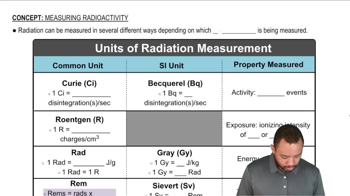
Units of Radiation Measurement

Volume Conversion

Volume conversion involves changing a measurement from one unit to another while maintaining the same quantity. To convert liters to microliters, one must multiply by the appropriate conversion factor. For example, since 1 L equals 1,000,000 µL, converting 20 mL to microliters requires multiplying 20 by 1,000, resulting in 20,000 µL.
Video consigliato:
Percorso guidato
02:38
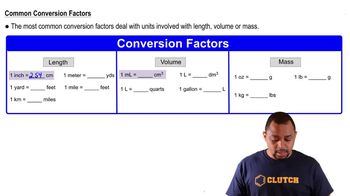
Common Conversion Factors

Scientific Notation

Scientific notation is a method of expressing very large or very small numbers in a compact form, using powers of ten. This notation is particularly useful in chemistry for dealing with measurements that span several orders of magnitude. For example, 1,000,000 can be expressed as 1 x 10^6, which simplifies calculations and comparisons in volume conversions.
Video consigliato:
Percorso guidato
02:50
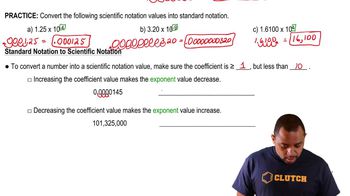
Standard Notation to Scientific Notation