Ch.1 - Chemical Tools: Experimentation & Measurement
McMurry - Chemistry 8th Edition
McMurry8th EditionChemistryISBN: 9781292336145Non è quello che usi tu?Cambia libro di testo
Capitolo 1, Problema 43

Which quantity in each of the following pairs is larger? (a) 5.63 * 106 cm or 6.02 * 101 km

Guida verificata passo dopo passo
1
Convert both quantities to the same unit for comparison. In this case, convert kilometers to centimeters.
Recall that 1 kilometer (km) is equal to 100,000 centimeters (cm).
Convert 6.02 \(\times\) 10^1 km to centimeters by multiplying by 100,000 cm/km.
Calculate the value of 6.02 \(\times\) 10^1 km in centimeters.
Compare the two values: 5.63 \(\times\) 10^6 cm and the converted value of 6.02 \(\times\) 10^1 km in cm to determine which is larger.

Risposta video verificata per un problema simile:

Questa soluzione video è stata consigliata dai nostri tutor come utile per risolvere questo problema.
Durata del video:
1m

Concetti chiave

Ecco i concetti essenziali che devi comprendere per rispondere correttamente alla domanda.

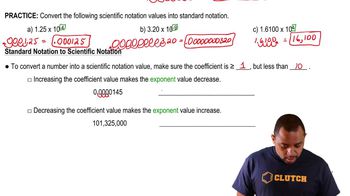
Scientific Notation

Scientific notation is a way of expressing numbers that are too large or too small to be conveniently written in decimal form. It is represented as a product of a number between 1 and 10 and a power of ten. For example, 5.63 * 10^6 means 5.63 multiplied by 1,000,000. Understanding this notation is essential for comparing large quantities.
Video consigliato:
Percorso guidato
02:50
Standard Notation to Scientific Notation

Unit Conversion

Unit conversion involves changing a quantity expressed in one unit to another unit. In this question, we need to convert kilometers to centimeters to make a direct comparison. Since 1 kilometer equals 100,000 centimeters, converting 6.02 * 10^1 km to centimeters is crucial for determining which quantity is larger.
Video consigliato:
Percorso guidato
01:56
Conversion Factors

Magnitude Comparison

Magnitude comparison refers to the process of determining which of two quantities is larger. This involves evaluating the numerical values and their respective units after any necessary conversions. By comparing the magnitudes of the two quantities in the same unit, we can accurately identify which one is larger.
Video consigliato:
Percorso guidato
02:33
Magnitude of Equilibrium Constant