Ch.1 - Chemical Tools: Experimentation & Measurement
McMurry - Chemistry 8th Edition
McMurry8th EditionChemistryISBN: 9781292336145Non è quello che usi tu?Cambia libro di testo
Capitolo 1, Problema 55

Of the 90 or so naturally occurring elements, only four are liquid near room temperature: mercury (melting point = -38.87 °C), bromine (melting point = -7.2 °C), cesium (melting point = 28.40 °C), and gallium (melting point = 29.78 °C). Convert these melting points to degrees Fahrenheit.

Guida verificata passo dopo passo
1
Identify the formula for converting Celsius to Fahrenheit: \( F = \frac{9}{5}C + 32 \).
Substitute the melting point of mercury (-38.87 °C) into the formula: \( F = \frac{9}{5}(-38.87) + 32 \).
Substitute the melting point of bromine (-7.2 °C) into the formula: \( F = \frac{9}{5}(-7.2) + 32 \).
Substitute the melting point of cesium (28.40 °C) into the formula: \( F = \frac{9}{5}(28.40) + 32 \).
Substitute the melting point of gallium (29.78 °C) into the formula: \( F = \frac{9}{5}(29.78) + 32 \).

Risposta video verificata per un problema simile:

Questa soluzione video è stata consigliata dai nostri tutor come utile per risolvere questo problema.
Durata del video:
1m

Concetti chiave

Ecco i concetti essenziali che devi comprendere per rispondere correttamente alla domanda.

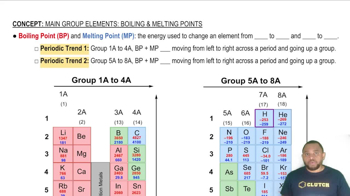
Melting Point

The melting point is the temperature at which a solid becomes a liquid at atmospheric pressure. It is a critical physical property that indicates the phase transition of a substance. For example, mercury melts at -38.87 °C, meaning it transitions from solid to liquid at this temperature.
Video consigliato:
Percorso guidato
04:29
Boiling Point and Melting Point

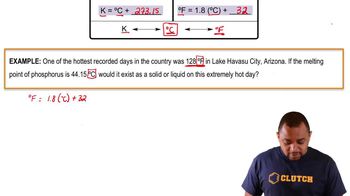
Temperature Conversion

Temperature conversion involves changing a temperature value from one scale to another, such as Celsius to Fahrenheit. The formula for converting Celsius to Fahrenheit is F = (C × 9/5) + 32. Understanding this conversion is essential for accurately interpreting temperature data across different measurement systems.
Video consigliato:
Percorso guidato
02:10
Temperature Conversion Example

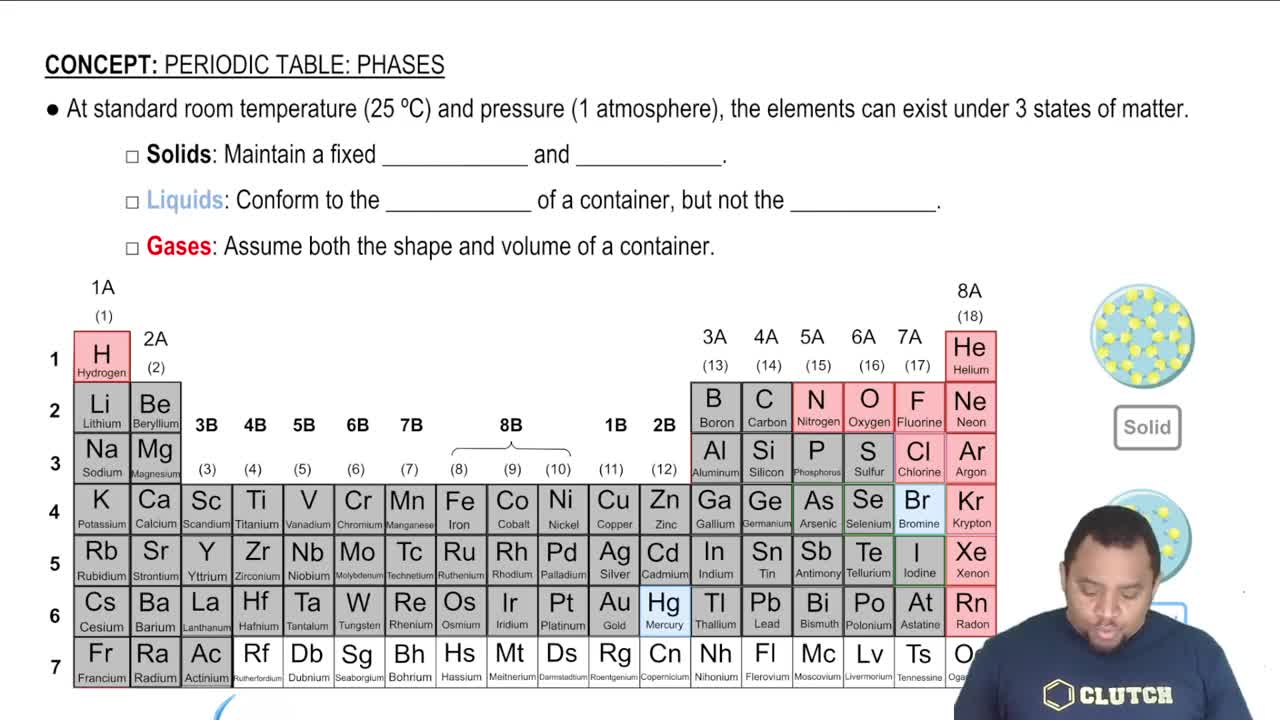
States of Matter

States of matter refer to the distinct forms that different phases of matter take on. The most common states are solid, liquid, and gas. The transition between these states, such as melting from solid to liquid, is influenced by temperature and pressure, which is crucial for understanding the behavior of elements like mercury and bromine near room temperature.
Video consigliato:
Percorso guidato
03:25
Element States of Matter