
Ch.10 - Gases: Their Properties & Behavior
McMurry - Chemistry 8th Edition
McMurry8th EditionChemistryISBN: 9781292336145Non è quello che usi tu?Cambia libro di testo
Capitolo 10, Problema 12

An unknown gas is found to diffuse through a porous membrane 2.92 times more slowly than H2. What is the molecular weight of the gas? (a) 17.0 g/mol (b) 5.84 g/mol (c) 8.52 g/mol

Guida verificata passo dopo passo
1
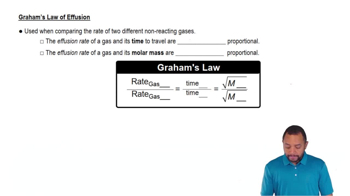
Identify the relevant law for diffusion of gases, which is Graham's Law of Effusion. This law states that the rate of effusion of a gas is inversely proportional to the square root of its molar mass.
Set up the equation based on Graham's Law: \( \frac{Rate_{H_2}}{Rate_{unknown}} = \sqrt{\frac{M_{unknown}}{M_{H_2}}} \), where \( M_{unknown} \) is the molar mass of the unknown gas and \( M_{H_2} \) is the molar mass of hydrogen (2 g/mol).
Plug in the given rate ratio into the equation: \( \frac{1}{2.92} = \sqrt{\frac{M_{unknown}}{2}} \).
Solve for \( M_{unknown} \) by squaring both sides of the equation and then multiplying by 2 to isolate \( M_{unknown} \) on one side.
Compare the calculated molar mass of the unknown gas with the given options to find the closest match.

Risposta video verificata per un problema simile:

Questa soluzione video è stata consigliata dai nostri tutor come utile per risolvere questo problema.
Durata del video:
3m

Concetti chiave

Ecco i concetti essenziali che devi comprendere per rispondere correttamente alla domanda.

Graham's Law of Effusion

Graham's Law states that the rate of effusion or diffusion of a gas is inversely proportional to the square root of its molar mass. This means that lighter gases diffuse faster than heavier gases. The relationship can be expressed mathematically as (Rate1/Rate2) = √(Molar Mass2/Molar Mass1), allowing for the comparison of diffusion rates between two gases.
Video consigliato:
Percorso guidato
2:03
Graham's Law of Effusion

Molar Mass

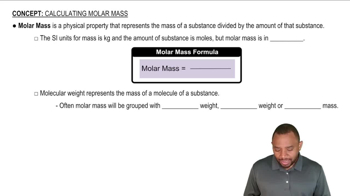
Molar mass is the mass of one mole of a substance, typically expressed in grams per mole (g/mol). It is a critical property in stoichiometry and gas calculations, as it helps determine the amount of substance present in a given volume or mass. For gases, knowing the molar mass allows for the application of gas laws and principles like Graham's Law.
Video consigliato:
Percorso guidato
02:11
Molar Mass Concept

Diffusion

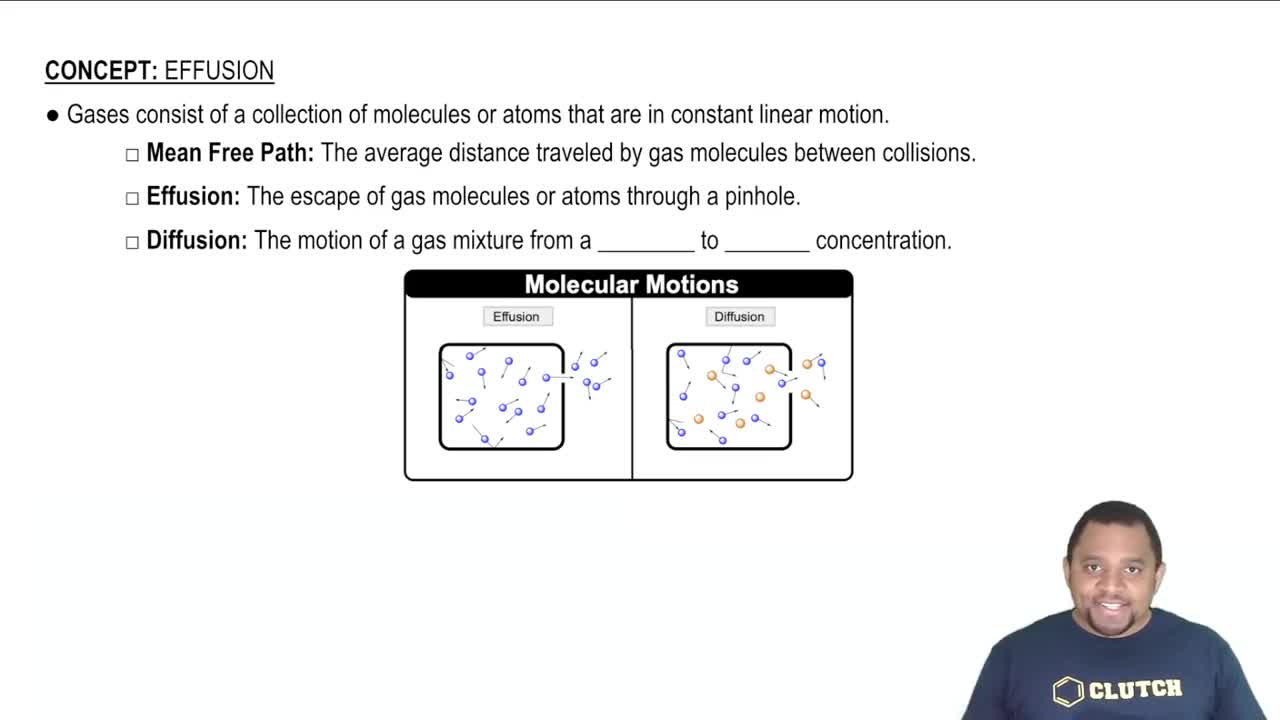
Diffusion is the process by which molecules spread from areas of high concentration to areas of low concentration. In the context of gases, diffusion occurs due to the random motion of gas particles. The rate of diffusion can be influenced by factors such as temperature, pressure, and the molecular weight of the gas, making it essential for understanding gas behavior in various scenarios.
Video consigliato:
Percorso guidato
02:33
Effusion vs Diffusion
Pratica correlata
Domanda del libro di testo
The coldest temperature recorded at ground level on Earth was -89.2 °C at the Vostok Station in Antarctica. What is the speed of a nitrogen molecule at this temperature? (LO 10.9) (a) 933 m/s (b) 40.2 m/s (c) 404 m/s (d) 12.8 m/s
740
views
Domanda del libro di testo
Identify the true statement about deviations from ideal gas behavior. (LO 10.12) (a) The attractive forces between gas particles cause the true volume of the sample to be larger than predicted by the ideal gas law. (b) The attractive forces between gas particles most influence the volume of a sample at low pressure. (c) The volume of the gas particles themselves most influences the volume of the sample at low pressure. (d) The volume of the gas particles themselves causes the true volume of the sample to be larger than predicted by the ideal gas law.
710
views
Domanda del libro di testo
A glass tube has one end in a dish of mercury and the other end closed by a stopcock. The distance from the surface of the mercury to the bottom of the stopcock is 850 mm. The apparatus is at 25 °C, and the mercury level in the tube is the same as that in the dish.

(a) Show on drawing (1) what the approximate level of mercury in the tube will be when the temperature of the entire apparatus is lowered from +25 °C to -25 °C.
477
views
Domanda del libro di testo

Two 112-L tanks are filled with gas at 330 K. One contains 5.00 mol of Kr, and the other contains 5.00 mol of O2. Considering the assumptions of kinetic–molecular theory, rank the gases from low to high for each of the following properties.

(c) Average speed

112
views
Domanda del libro di testo

Assume that you have a sample of gas in a cylinder with a movable piston, as shown in the following drawing:

Redraw the apparatus to show what the sample will look like after (a) the temperature is increased from 300 K to 450 K at constant pressure

686
views
Domanda del libro di testo

Two identical 732.0-L tanks each contain 212.0 g of gas at 293 K, with neon in one tank and nitrogen in the other. Based on the assumptions of kinetic–molecular theory, rank the gases from low to high for each of the following properties.

(a) Average speed

107
views