
Ch.10 - Gases: Their Properties & Behavior
McMurry - Chemistry 8th Edition
McMurry8th EditionChemistryISBN: 9781292336145Non è quello che usi tu?Cambia libro di testo
Capitolo 10, Problema 112

Assume that you have 0.500 mol of N2 in a volume of 0.600 L at 300 K. Calculate the pressure in atmospheres using both the ideal gas law and the van der Waals equation. For N2, a = 1.351 L^2 atm/mol^2 and b = 0.0387 L/mol.

Guida verificata passo dopo passo
1
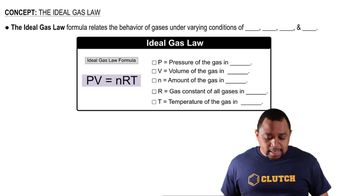
Step 1: Start with the ideal gas law equation, which is given by \( PV = nRT \). Here, \( P \) is the pressure, \( V \) is the volume, \( n \) is the number of moles, \( R \) is the ideal gas constant (0.0821 L atm/mol K), and \( T \) is the temperature in Kelvin.
Step 2: Substitute the given values into the ideal gas law equation: \( n = 0.500 \) mol, \( V = 0.600 \) L, \( T = 300 \) K, and \( R = 0.0821 \) L atm/mol K. Solve for \( P \) by rearranging the equation to \( P = \frac{nRT}{V} \).
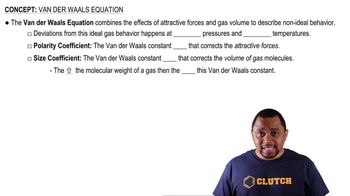
Step 3: For the van der Waals equation, use the formula \( \left( P + \frac{an^2}{V^2} \right)(V - nb) = nRT \). Here, \( a \) and \( b \) are van der Waals constants specific to the gas, with \( a = 1.351 \) L^2 atm/mol^2 and \( b = 0.0387 \) L/mol for N2.
Step 4: Substitute the given values into the van der Waals equation: \( n = 0.500 \) mol, \( V = 0.600 \) L, \( T = 300 \) K, \( a = 1.351 \) L^2 atm/mol^2, and \( b = 0.0387 \) L/mol. Rearrange the equation to solve for \( P \).
Step 5: Compare the pressure calculated using the ideal gas law with the pressure calculated using the van der Waals equation to understand the effect of intermolecular forces and molecular volume on the behavior of real gases.

Concetti chiave

Ecco i concetti essenziali che devi comprendere per rispondere correttamente alla domanda.

Ideal Gas Law

The Ideal Gas Law is a fundamental equation in chemistry that relates the pressure (P), volume (V), number of moles (n), and temperature (T) of an ideal gas through the equation PV = nRT. Here, R is the ideal gas constant. This law assumes that gas particles do not interact and occupy no volume, making it a good approximation under many conditions, particularly at high temperatures and low pressures.
Video consigliato:
Percorso guidato
01:15
Ideal Gas Law Formula

Van der Waals Equation

The Van der Waals equation is an adjustment of the Ideal Gas Law that accounts for the volume occupied by gas molecules and the attractive forces between them. It is expressed as (P + a(n/V)^2)(V - nb) = nRT, where 'a' and 'b' are constants specific to each gas. This equation provides a more accurate description of real gas behavior, especially under high pressure and low temperature conditions.
Video consigliato:
Percorso guidato
01:40
Van der Waals Equation

Real Gases vs. Ideal Gases

Real gases deviate from ideal behavior due to intermolecular forces and the finite volume of gas particles. While the Ideal Gas Law assumes no interactions and negligible volume, real gases exhibit attractions and repulsions that can affect pressure and volume. Understanding these differences is crucial when applying the Ideal Gas Law and the Van der Waals equation to predict gas behavior accurately.
Video consigliato:
Percorso guidato
02:27
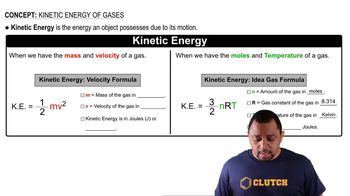
Kinetic Energy Formulas