Ch.10 - Gases: Their Properties & Behavior
McMurry - Chemistry 8th Edition
McMurry8th EditionChemistryISBN: 9781292336145Non è quello che usi tu?Cambia libro di testo
Capitolo 10, Problema 42

Assume that you have an open-end manometer filled with ethyl alcohol 1density = 0.7893 g>mL at 20 °C2 rather than mercury 1density = 13.546 g>mL at 20 °C2. What is the pressure in pascals if the level in the arm open to the atmosphere is 55.1 cm higher than the level in the arm connected to the gas sample and the atmospheric pressure reading is 752.3 mm Hg?

Guida verificata passo dopo passo
1
Convert the atmospheric pressure from mm Hg to pascals. Recall that 1 mm Hg equals 133.322 pascals.
Calculate the density difference between the ethyl alcohol and the atmosphere by using the given density of ethyl alcohol and converting it to pascals. Use the formula: \( \text{Pressure difference} = \text{height difference} \times \text{density of fluid} \times \text{gravitational acceleration} \).
Convert the height difference from cm to meters for use in the formula.
Add the pressure difference calculated from the ethyl alcohol column to the atmospheric pressure (converted to pascals) if the ethyl alcohol column is higher on the side open to the atmosphere, or subtract if it is lower.
The result from the previous step will give you the pressure in pascals of the gas sample connected to the manometer.

Risposta video verificata per un problema simile:

Questa soluzione video è stata consigliata dai nostri tutor come utile per risolvere questo problema.
Durata del video:
4m

Concetti chiave

Ecco i concetti essenziali che devi comprendere per rispondere correttamente alla domanda.

Manometer Functionality

A manometer is a device used to measure the pressure of gases. It consists of a U-shaped tube filled with a liquid, where the difference in liquid height between the two arms indicates the pressure difference between the gas and the atmosphere. The height difference is influenced by the density of the liquid used, which in this case is ethyl alcohol instead of mercury.
Video consigliato:
Percorso guidato
03:37
Logarithmic Functions

Pressure Conversion

Pressure is often measured in different units, such as pascals (Pa) and millimeters of mercury (mm Hg). To convert between these units, one must use the appropriate conversion factors. For example, 1 mm Hg is equivalent to approximately 133.322 Pa. Understanding how to convert these units is essential for accurately calculating the pressure in pascals from the given atmospheric pressure and the height difference in the manometer.
Video consigliato:
Percorso guidato
02:20
Pressure Conversion Example

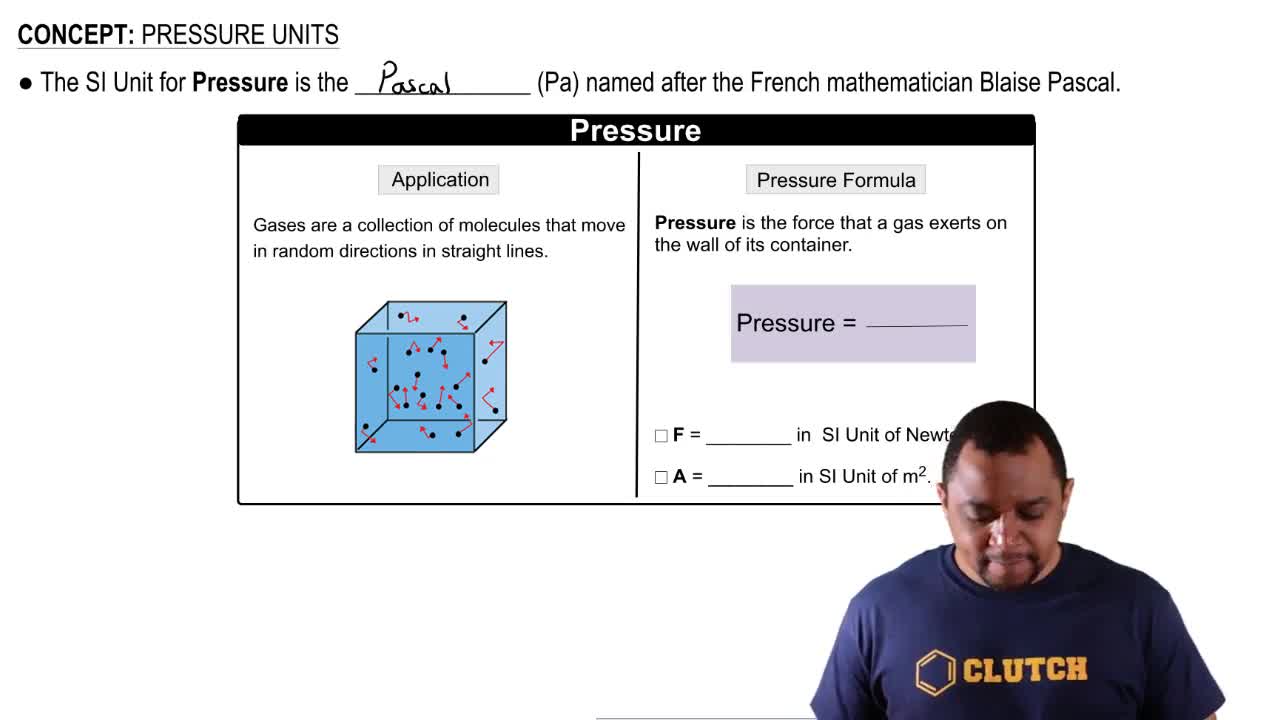
Hydrostatic Pressure Equation

The hydrostatic pressure equation relates the pressure difference to the height of the liquid column and its density. It is given by the formula ΔP = ρgh, where ΔP is the pressure difference, ρ is the density of the liquid, g is the acceleration due to gravity, and h is the height difference. This equation is crucial for determining the pressure exerted by the liquid column in the manometer when calculating the pressure of the gas sample.
Video consigliato: