Ch.10 - Gases: Their Properties & Behavior
McMurry - Chemistry 8th Edition
McMurry8th EditionChemistryISBN: 9781292336145Non è quello che usi tu?Cambia libro di testo
Capitolo 10, Problema 41

What is the pressure in atmospheres inside a container of gas connected to a mercury-filled open-end manometer when the level in the arm connected to the container is 28.3 cm higher than the level in the arm open to the atmosphere and the atmospheric pressure reading outside the apparatus is 1.021 atm?

Guida verificata passo dopo passo
1
Identify the type of manometer: Since the level in the arm connected to the container is higher, it indicates that the gas pressure inside the container is less than the atmospheric pressure.
Convert the height difference from cm to mm: Since 1 cm = 10 mm, multiply the height difference by 10 to convert it to mm.
Calculate the pressure difference: The pressure difference is equal to the height difference in mm of mercury (mmHg).
Convert the pressure difference to atmospheres: Use the conversion factor 1 atm = 760 mmHg to convert the pressure difference from mmHg to atm.
Determine the gas pressure inside the container: Subtract the pressure difference (in atm) from the atmospheric pressure to find the pressure inside the container.

Risposta video verificata per un problema simile:

Questa soluzione video è stata consigliata dai nostri tutor come utile per risolvere questo problema.
Durata del video:
4m

Concetti chiave

Ecco i concetti essenziali che devi comprendere per rispondere correttamente alla domanda.

Manometer

A manometer is a device used to measure the pressure of a gas by comparing it to atmospheric pressure. It typically consists of a U-shaped tube filled with a liquid, such as mercury. The difference in liquid height between the two arms of the manometer indicates the pressure difference, allowing for the calculation of the gas pressure in relation to atmospheric pressure.

Atmospheric Pressure

Atmospheric pressure is the pressure exerted by the weight of the air in the Earth's atmosphere. It is commonly measured in atmospheres (atm) or other units like mmHg. Standard atmospheric pressure at sea level is defined as 1 atm, which is equivalent to 760 mmHg. Understanding atmospheric pressure is crucial for interpreting manometer readings and calculating gas pressures.
Video consigliato:
Percorso guidato
02:09
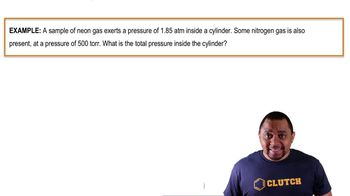
Total Pressure Example

Pressure Calculation

To find the pressure of the gas in the container using a manometer, one must account for the height difference in the mercury levels and the atmospheric pressure. If the mercury level in the arm connected to the gas is higher, the gas pressure is lower than atmospheric pressure. The gas pressure can be calculated by subtracting the height difference (converted to pressure units) from the atmospheric pressure.
Video consigliato:
Percorso guidato
00:48
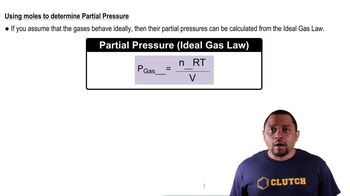
Partial Pressure Calculation