Ch.10 - Gases: Their Properties & Behavior
McMurry - Chemistry 8th Edition
McMurry8th EditionChemistryISBN: 9781292336145Non è quello che usi tu?Cambia libro di testo
Capitolo 10, Problema 96

At what temperature (°C) will xenon atoms have the same average speed that Br2 molecules have at 20° C?

Guida verificata passo dopo passo
1
Identify the given information: The temperature of Br2 molecules is 20°C, and we need to find the temperature at which Xe atoms have the same average speed.
Convert the given temperature of Br2 from Celsius to Kelvin by using the formula: T(K) = T(°C) + 273.15. This conversion is necessary because all thermodynamic calculations must be done in Kelvin.
Use the formula for the average speed of gas particles, which is given by \( v = \sqrt{\frac{3kT}{m}} \), where \( v \) is the average speed, \( k \) is the Boltzmann constant, \( T \) is the temperature in Kelvin, and \( m \) is the molar mass of the gas.
Set up an equation where the average speed of Xe at an unknown temperature \( T_{Xe} \) equals the average speed of Br2 at 293.15 K. This equation will be \( \sqrt{\frac{3kT_{Xe}}{m_{Xe}}} = \sqrt{\frac{3k \times 293.15}{m_{Br2}}} \).
Solve for \( T_{Xe} \) by isolating it on one side of the equation. Simplify and solve the equation to find the temperature in Kelvin, then convert it back to Celsius for the final answer.

Risposta video verificata per un problema simile:

Questa soluzione video è stata consigliata dai nostri tutor come utile per risolvere questo problema.
Durata del video:
10m

Concetti chiave

Ecco i concetti essenziali che devi comprendere per rispondere correttamente alla domanda.

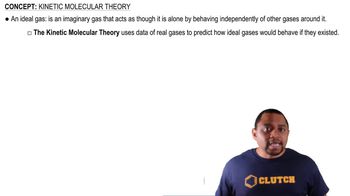
Kinetic Molecular Theory

The Kinetic Molecular Theory explains the behavior of gases in terms of particles in constant motion. It states that the average kinetic energy of gas particles is directly proportional to the temperature of the gas in Kelvin. This theory helps in understanding how temperature affects the speed of gas molecules, which is crucial for comparing the speeds of xenon atoms and bromine molecules.
Video consigliato:
Percorso guidato
01:19
Kinetic Molecular Theory

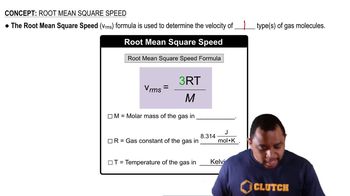
Root Mean Square Speed

Root Mean Square Speed (rms speed) is a measure of the average speed of particles in a gas. It is calculated using the formula v_rms = sqrt(3RT/M), where R is the gas constant, T is the temperature in Kelvin, and M is the molar mass of the gas. This concept is essential for determining the temperature at which xenon atoms will match the average speed of bromine molecules at a given temperature.
Video consigliato:
Percorso guidato
01:05
Root Mean Square Speed Formula

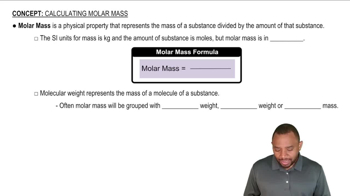
Molar Mass

Molar mass is the mass of one mole of a substance, typically expressed in grams per mole (g/mol). It plays a critical role in calculations involving gas behavior, as it influences the rms speed of gas particles. In this question, knowing the molar masses of xenon and bromine is necessary to find the temperature at which their average speeds are equal.
Video consigliato:
Percorso guidato
02:11
Molar Mass Concept