Ch.10 - Gases: Their Properties & Behavior
McMurry - Chemistry 8th Edition
McMurry8th EditionChemistryISBN: 9781292336145Non è quello che usi tu?Cambia libro di testo
Capitolo 10, Problema 95

Calculate the average speed of a nitrogen molecule in m/s on a hot day in summer 1T = 37 °C2 and on a cold day in winter 1T = -25 °C2.

Guida verificata passo dopo passo
1
Convert the temperatures from Celsius to Kelvin by adding 273.15 to each temperature.
Use the formula for the root-mean-square speed of a gas molecule: \( v_{rms} = \sqrt{\frac{3kT}{m}} \), where \( k \) is the Boltzmann constant \( 1.38 \times 10^{-23} \text{ J/K} \), \( T \) is the temperature in Kelvin, and \( m \) is the mass of a nitrogen molecule.
Calculate the molar mass of nitrogen \( N_2 \) in kg by converting from grams per mole to kilograms per molecule using Avogadro's number.
Substitute the values for the Boltzmann constant, the converted temperature, and the mass of a nitrogen molecule into the root-mean-square speed formula for both temperatures.
Solve the equation for each temperature to find the average speed of a nitrogen molecule on a hot day and a cold day.

Risposta video verificata per un problema simile:

Questa soluzione video è stata consigliata dai nostri tutor come utile per risolvere questo problema.
Durata del video:
5m

Concetti chiave

Ecco i concetti essenziali che devi comprendere per rispondere correttamente alla domanda.

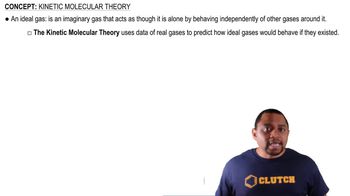
Kinetic Molecular Theory

Kinetic Molecular Theory explains the behavior of gases in terms of particles in constant motion. It posits that the temperature of a gas is directly related to the average kinetic energy of its molecules. Therefore, as temperature increases, the average speed of the gas molecules also increases, which is crucial for calculating the average speed of nitrogen molecules at different temperatures.
Video consigliato:
Percorso guidato
01:19
Kinetic Molecular Theory

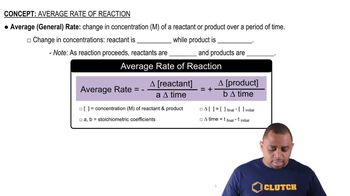
Average Speed of Gas Molecules

The average speed of gas molecules can be calculated using the formula derived from the kinetic energy of the molecules. For an ideal gas, the average speed (v) is proportional to the square root of the temperature in Kelvin (T) and inversely proportional to the square root of the molar mass (M) of the gas. This relationship allows us to determine how temperature changes affect molecular speed.
Video consigliato:
Percorso guidato
02:03
Average Rate of Reaction

Temperature Conversion

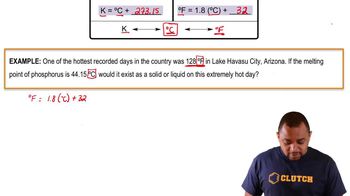
To accurately calculate the average speed of nitrogen molecules at different temperatures, it is essential to convert Celsius temperatures to Kelvin. The conversion is done by adding 273.15 to the Celsius temperature. This step is necessary because the kinetic energy calculations require absolute temperature values, which are represented in Kelvin.
Video consigliato:
Percorso guidato
02:10
Temperature Conversion Example