Ch.10 - Gases: Their Properties & Behavior
McMurry - Chemistry 8th Edition
McMurry8th EditionChemistryISBN: 9781292336145Non è quello che usi tu?Cambia libro di testo
Capitolo 10, Problema 59

Dry ice (solid CO2) has occasionally been used as an 'explosive' in mining. A hole is drilled, dry ice and a small amount of gunpowder are placed in the hole, a fuse is added, and the hole is plugged. When lit, the exploding gunpowder rapidly vaporizes the dry ice, building up an immense pressure. Assume that 500.0 g of dry ice is placed in a cavity with a volume of 0.800 L and the ignited gunpowder heats the CO2 to 700 K. What is the final pressure inside the hole?

Guida verificata passo dopo passo
1
Step 1: Identify the given information. The mass of dry ice (CO2) is 500.0 g, the volume of the cavity is 0.800 L, and the final temperature is 700 K.
Step 2: Convert the mass of CO2 to moles. You can do this by dividing the mass of CO2 by its molar mass. The molar mass of CO2 is approximately 44.01 g/mol.
Step 3: Use the ideal gas law equation, PV = nRT, to solve for the final pressure. In this equation, P is the pressure, V is the volume, n is the number of moles, R is the ideal gas constant, and T is the temperature. The ideal gas constant (R) can be taken as 0.0821 L·atm/(K·mol) when the volume is in liters and the temperature is in Kelvin.
Step 4: Substitute the known values into the ideal gas law equation. The number of moles (n) is the value you calculated in step 2, the volume (V) is 0.800 L, the temperature (T) is 700 K, and the ideal gas constant (R) is 0.0821 L·atm/(K·mol).
Step 5: Solve the equation for the pressure (P). This will give you the final pressure inside the hole.

Risposta video verificata per un problema simile:

Questa soluzione video è stata consigliata dai nostri tutor come utile per risolvere questo problema.
Durata del video:
5m

Concetti chiave

Ecco i concetti essenziali che devi comprendere per rispondere correttamente alla domanda.

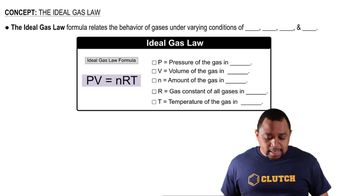
Ideal Gas Law

The Ideal Gas Law relates the pressure, volume, temperature, and number of moles of a gas through the equation PV = nRT. This law is essential for calculating the final pressure of gases under varying conditions, as it allows us to understand how changes in temperature and volume affect gas behavior.
Video consigliato:
Percorso guidato
01:15
Ideal Gas Law Formula

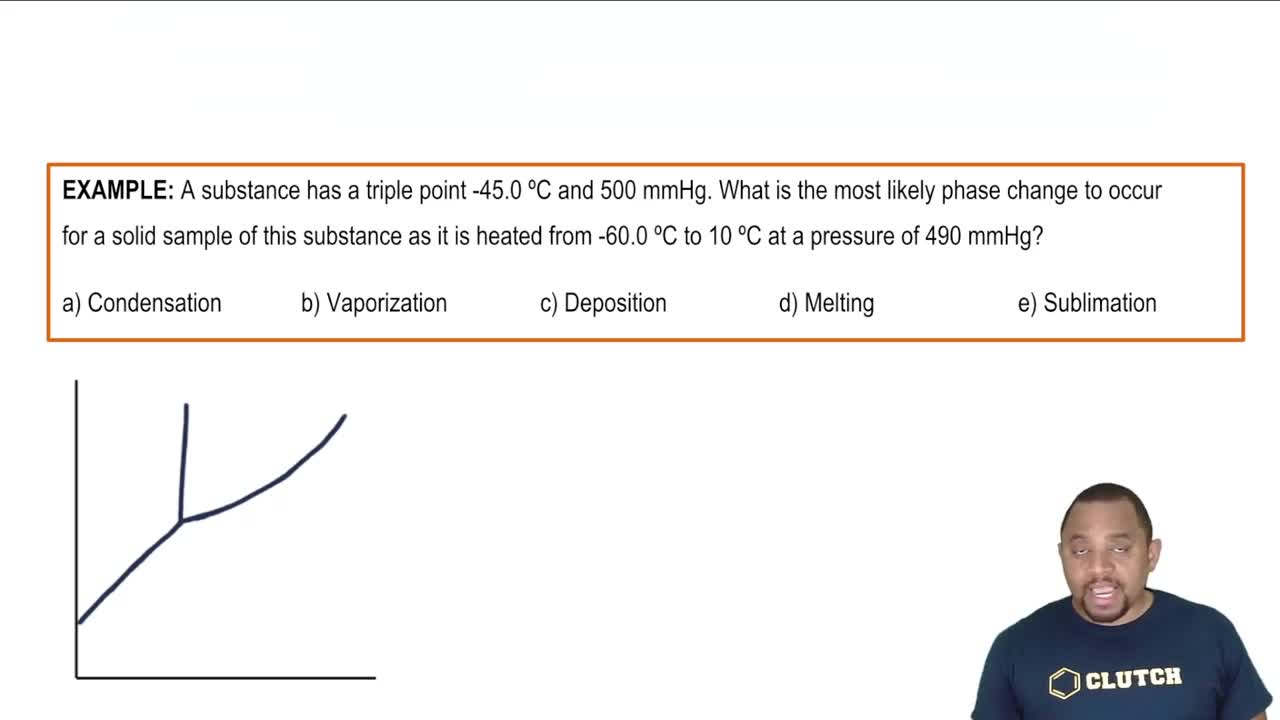
Phase Changes and Sublimation

Dry ice is solid carbon dioxide that sublimates directly into gas at temperatures above -78.5 °C. Understanding sublimation is crucial in this scenario, as the rapid transition from solid to gas contributes to the pressure buildup when the dry ice is heated by the ignited gunpowder.
Video consigliato:
Percorso guidato
01:52
Sublimation Phase Change Example

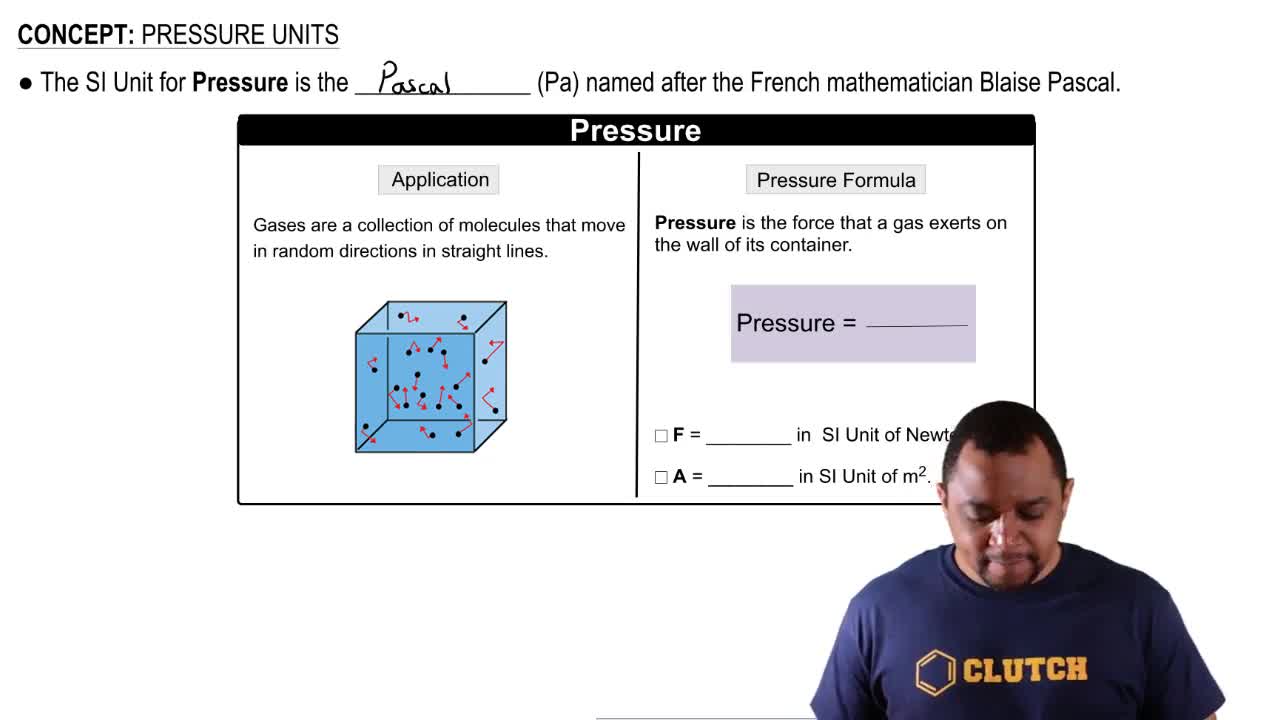
Pressure Units and Conversions

Pressure is commonly measured in units such as atmospheres (atm), pascals (Pa), or mmHg. In this problem, it is important to ensure that the final pressure is expressed in a consistent unit, which may require converting from one unit to another based on the context of the question.
Video consigliato: