
Ch.10 - Gases: Their Properties & Behavior
McMurry - Chemistry 8th Edition
McMurry8th EditionChemistryISBN: 9781292336145Non è quello che usi tu?Cambia libro di testo
Capitolo 10, Problema 138

When solid mercury(I) carbonate, Hg2CO3, is added to nitric acid, HNO3, a reaction occurs to give mercury(II) nitrate, Hg1NO322, water, and two gases A and B: Hg2CO31s2 + HNO31aq2¡ Hg1NO3221aq2 + H2O1l 2 + A1g2 + B1g2 (a) When the gases are placed in a 500.0-mL bulb at 20 °C, the pressure is 258 mm Hg. How many moles of gas are present?

Guida verificata passo dopo passo
1
Identify the gases A and B produced in the reaction. In this reaction, the gases are likely carbon dioxide (CO2) and nitrogen dioxide (NO2).
Use the ideal gas law equation, PV = nRT, where P is the pressure, V is the volume, n is the number of moles of gas, R is the gas constant, and T is the temperature.
Convert the given pressure from mm Hg to atmospheres (atm) as the gas constant R is typically used with pressure in atm. Use the conversion factor 1 atm = 760 mm Hg.
Convert the temperature from degrees Celsius to Kelvin by adding 273.15 to the Celsius temperature.
Substitute the converted pressure, the volume in liters, the converted temperature, and the gas constant (use R = 0.0821 L atm / K mol for consistency) into the ideal gas law equation to solve for n, the number of moles of gas.

Risposta video verificata per un problema simile:

Questa soluzione video è stata consigliata dai nostri tutor come utile per risolvere questo problema.
Durata del video:
3m

Concetti chiave

Ecco i concetti essenziali che devi comprendere per rispondere correttamente alla domanda.

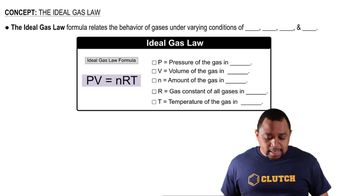
Ideal Gas Law

The Ideal Gas Law relates the pressure, volume, temperature, and number of moles of a gas through the equation PV = nRT. Here, P is the pressure in atmospheres, V is the volume in liters, n is the number of moles, R is the ideal gas constant, and T is the temperature in Kelvin. This law is essential for calculating the number of moles of gas produced in a reaction when given the pressure, volume, and temperature.
Video consigliato:
Percorso guidato
01:15
Ideal Gas Law Formula

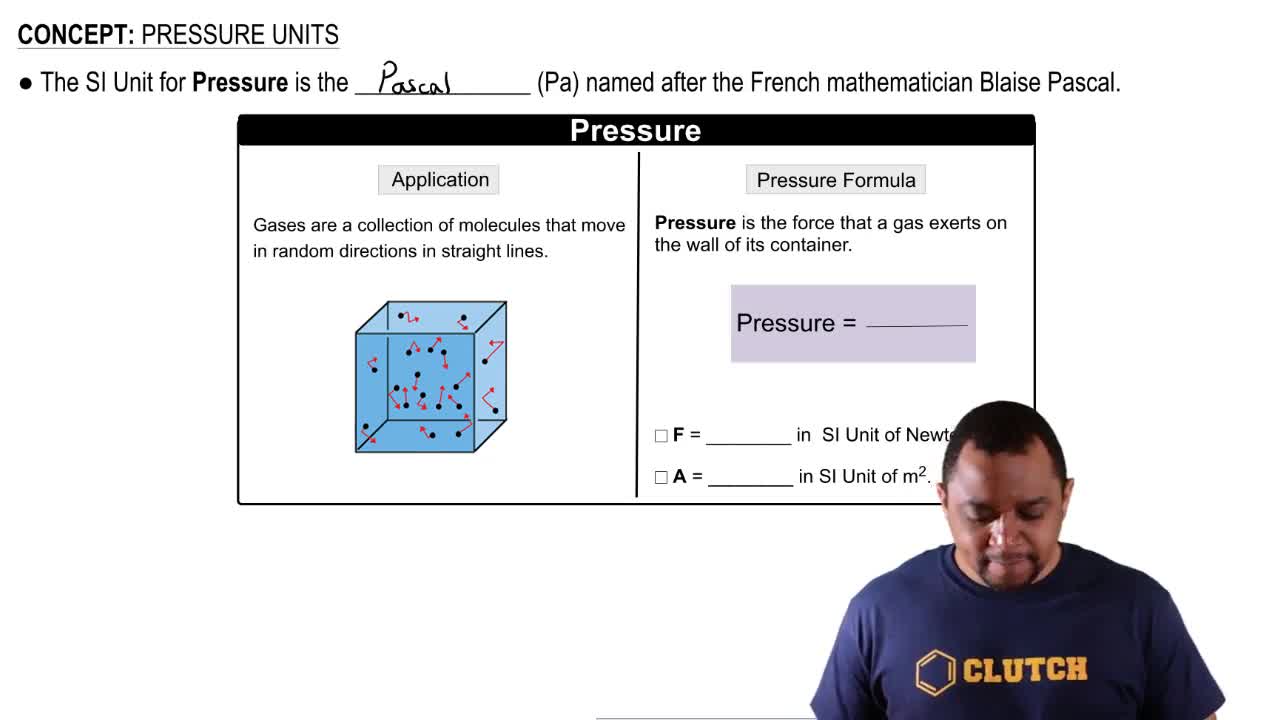
Gas Pressure Units

Gas pressure can be measured in various units, including mm Hg, atm, and pascals. In this question, the pressure is given in mm Hg, which can be converted to atmospheres (1 atm = 760 mm Hg) for use in the Ideal Gas Law. Understanding how to convert between these units is crucial for accurate calculations in gas-related problems.
Video consigliato:

Stoichiometry of Gas Reactions

Stoichiometry involves the quantitative relationships between reactants and products in a chemical reaction. In this case, knowing the balanced chemical equation allows us to determine the moles of gases produced from the reaction of mercury(I) carbonate with nitric acid. This understanding is vital for calculating the number of moles of gases A and B formed during the reaction.
Video consigliato:
Percorso guidato
00:47
Gas Stoichiometry Concepts
Pratica correlata
Domanda del libro di testo

The apparatus shown consists of three temperature-jacketed 1.000-L bulbs connected by stopcocks. Bulb A contains a mixture of H2O(g), CO2(g), and N2(g) at 25 °C and a total pressure of 564 mm Hg. Bulb B is empty and is held at a temperature of -70 °C. Bulb C is also empty and is held at a temperature of -190 °C. The stopcocks are closed, and the volume of the lines connecting the bulbs is zero. CO2 sublimes at -78 °C, and N2 boils at -196 °C.

(b) How many moles of H2O are in the system?

768
views
Domanda del libro di testo
When 10.0 g of a mixture of Ca1ClO322 and Ca1ClO22 is heated to 700 °C in a 10.0-L vessel, both compounds decompose, forming O21g2 and CaCl21s2. The final pressure inside the vessel is 1.00 atm. (b) What is the mass of each compound in the original mixture?
596
views
Domanda del libro di testo

The apparatus shown consists of three temperature-jacketed 1.000-L bulbs connected by stopcocks. Bulb A contains a mixture of H2O(g), CO2(g), and N2(g) at 25 °C and a total pressure of 564 mm Hg. Bulb B is empty and is held at a temperature of -70 °C. Bulb C is also empty and is held at a temperature of -190 °C. The stopcocks are closed, and the volume of the lines connecting the bulbs is zero. CO2 sublimes at -78 °C, and N2 boils at -196 °C.

(a) The stopcock between A and B is opened, and the system is allowed to come to equilibrium. The pressure in A and B is now 219 mm Hg. What do bulbs A and B contain?

401
views
Domanda del libro di testo
A mixture of CS21g2 and excess O21g2 is placed in a 10.0-L reaction vessel at 100.0 °C and a pressure of 3.00 atm. A spark causes the CS2 to ignite, burning it completely, according to the equation CS21g2 + 3 O21g2¡CO21g2 + 2 SO21g2 After reaction, the temperature returns to 100.0 °C, and the mixture of product gases (CO2, SO2, and unreacted O2) is found to have a pressure of 2.40 atm. What is the partial pressure of each gas in the product mixture?
416
views
Domanda del libro di testo
Assume that you take a flask, evacuate it to remove all the air, and find its mass to be 478.1 g. You then fill the flask with argon to a pressure of 2.15 atm and reweigh it. What would the balance read in grams if the flask has a volume of 7.35 L and the temperature is 20.0 °C?
680
views