Ch.11 - Liquids & Phase Changes
McMurry - Chemistry 8th Edition
McMurry8th EditionChemistryISBN: 9781292336145Non è quello che usi tu?Cambia libro di testo
Capitolo 11, Problema 18

A phase diagram for a substance that exhibits the liquid crystalline state is shown. (b) If the substance is at a temperature and pressure repre- sented by point 1 and the temperature is increased until the phase changes, what is the phase transition? Describe how the ordering of molecules changes, and propose a reason for the change.Phase diagram showing crystalline solid, smectic, nematic, and isotropic phases.

Guida verificata passo dopo passo
1
Identify the initial phase of the substance at point 1 on the phase diagram.
Determine the direction of the temperature change (increase) and follow the path on the phase diagram.
Observe the phase boundary that is crossed first as the temperature increases.
Identify the new phase after crossing the boundary and describe the phase transition.
Explain the molecular ordering in the initial and final phases and propose a reason for the change in ordering.

Risposta video verificata per un problema simile:

Questa soluzione video è stata consigliata dai nostri tutor come utile per risolvere questo problema.
Durata del video:
2m

Concetti chiave

Ecco i concetti essenziali che devi comprendere per rispondere correttamente alla domanda.

Phase Diagram

A phase diagram is a graphical representation that shows the phases of a substance as a function of temperature and pressure. It delineates the boundaries between different phases, such as solid, liquid, and gas, and indicates the conditions under which these phases exist. In the context of liquid crystals, the diagram also includes regions for smectic, nematic, and isotropic phases, which are crucial for understanding phase transitions.
Video consigliato:
Percorso guidato
03:22
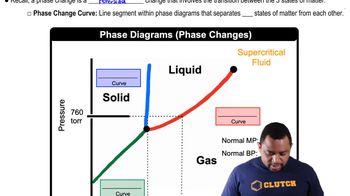
Phase Changes in Diagrams

Liquid Crystalline Phases

Liquid crystals are materials that exhibit properties between those of conventional liquids and solid crystals. The smectic and nematic phases are two types of liquid crystalline states. In the smectic phase, molecules are organized in layers, while in the nematic phase, they are aligned but not layered. Understanding these phases is essential for predicting how molecular ordering changes during phase transitions.
Video consigliato:
Percorso guidato
01:31
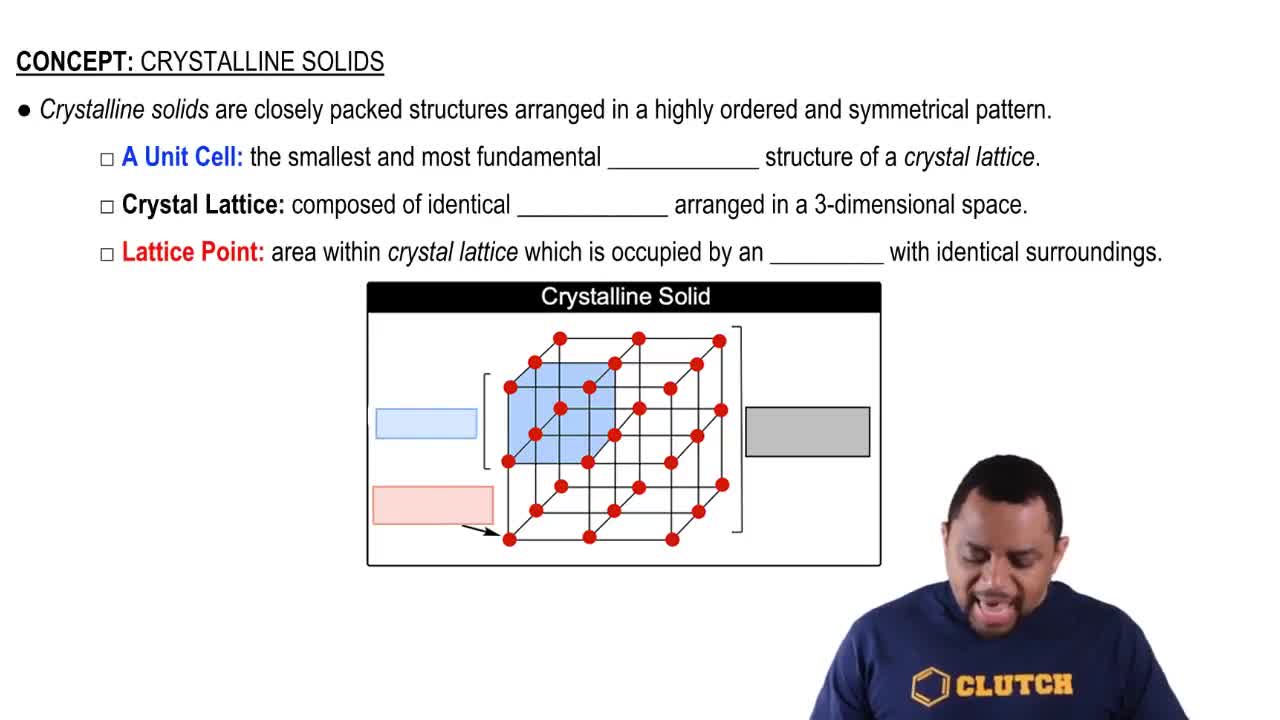
Crystalline Solids Structure

Phase Transition

A phase transition refers to the transformation of a substance from one phase to another, such as from solid to liquid or from liquid to gas. In the context of the question, as the temperature increases at a constant pressure, the substance may transition from a smectic or nematic phase to an isotropic phase. This transition involves a change in molecular ordering, where the structured arrangement of molecules in the smectic or nematic phase becomes more random in the isotropic phase.
Video consigliato:
Percorso guidato
03:22
Phase Changes in Diagrams
Pratica correlata
Domanda del libro di testo
Water flows quickly through the narrow neck of a bottle, but maple syrup flows sluggishly. Is this different behavior due to a difference in viscosity or in surface tension for the liquids?
354
views

Domanda del libro di testo
Predict which substance in each pair has the highest surface tension. (a) CCl4 or CH2Br2
888
views
Domanda del libro di testo
The DNA base thymine dissolves in water due to hydrogen bonding. Which of the following hydrogen bonds drawn between thymine and surrounding water molecules are valid? (LO 8.10) (a) I and II (b) I, II, IV (c) I, II, III (d) III and IV
553
views
Domanda del libro di testo

Assume that you have a liquid in a cylinder equipped with a movable piston. There is no air in the cylinder, the volume of space above the liquid is 200 mL, and the equilibrium vapor pressure above the liquid is 28.0 mm Hg. What is the equilibrium pressure above the liquid when the volume of space is decreased from 200 mL to 100 mL at constant temperature?

689
views
1
rank
Domanda del libro di testo
The following compound undergoes a phase transition from the solid to the smectic liquid crystal phase at 121 °C. Upon further heating, the compound undergoes another transition to liquid phase at 131 °C.

(a) Which image represents the arrangement of molecules at 125 °C?
336
views
Domanda del libro di testo
Arrange the following molecules from lowest to highest boiling point. (LO 8.9) (I)

(II)

(III)

(IV)

(a) I 6 II 6 III 6 IV (b) II 6 III 6 I 6 IV (c) IV 6 II 6 III 6 I (d) IV 6 I 6 II 6 III
697
views