
Ch.11 - Liquids & Phase Changes
McMurry - Chemistry 8th Edition
McMurry8th EditionChemistryISBN: 9781292336145Non è quello che usi tu?Cambia libro di testo
Capitolo 11, Problema 14

The DNA base thymine dissolves in water due to hydrogen bonding. Which of the following hydrogen bonds drawn between thymine and surrounding water molecules are valid? (LO 8.10) (a) I and II (b) I, II, IV (c) I, II, III (d) III and IV

Guida verificata passo dopo passo
1
Identify the hydrogen bonding sites on thymine. Thymine has oxygen and nitrogen atoms that can act as hydrogen bond acceptors.
Examine the hydrogen bonding capability of water. Water molecules can form hydrogen bonds through their hydrogen atoms (as donors) and oxygen atoms (as acceptors).
Analyze each option to determine if the hydrogen bonds depicted are valid. A valid hydrogen bond typically forms between a hydrogen atom attached to a highly electronegative atom (like oxygen or nitrogen) and a lone pair of electrons on another electronegative atom.
Check if the hydrogen bonds in options (a), (b), (c), and (d) follow the rule where the hydrogen atom of the water molecule should be pointing towards the electronegative atom (oxygen or nitrogen) of thymine.
Eliminate any options where the hydrogen bonds do not align correctly according to the hydrogen bonding rules.

Risposta video verificata per un problema simile:

Questa soluzione video è stata consigliata dai nostri tutor come utile per risolvere questo problema.
Durata del video:
3m

Concetti chiave

Ecco i concetti essenziali che devi comprendere per rispondere correttamente alla domanda.

Hydrogen Bonding

Hydrogen bonding is a type of attractive interaction between a hydrogen atom covalently bonded to a highly electronegative atom (like oxygen or nitrogen) and another electronegative atom. In the context of thymine and water, hydrogen bonds form between the hydrogen atoms of water molecules and the electronegative nitrogen and oxygen atoms in thymine, facilitating its solubility in water.
Video consigliato:
Percorso guidato
01:22
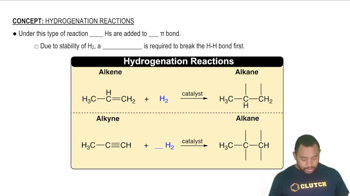
Hydrogenation Reactions

Polarity of Molecules

Polarity refers to the distribution of electrical charge over the atoms in a molecule. Water is a polar molecule, meaning it has a partial positive charge on one side (hydrogens) and a partial negative charge on the other (oxygen). This polarity allows water to interact effectively with other polar molecules, such as thymine, through hydrogen bonds, enhancing its solubility.
Video consigliato:
Percorso guidato
02:38
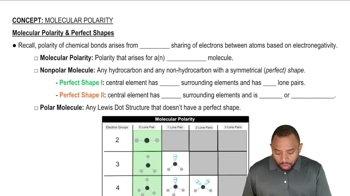
Molecular Polarity

Molecular Interactions

Molecular interactions encompass various forces that occur between molecules, including hydrogen bonds, ionic interactions, and van der Waals forces. Understanding these interactions is crucial for predicting how molecules like thymine will behave in solution, as the strength and number of hydrogen bonds formed with surrounding water molecules will determine the overall solubility and stability of the compound in an aqueous environment.
Video consigliato:
Percorso guidato
02:38
Molecular Polarity
Pratica correlata
Domanda del libro di testo
A phase diagram for a substance that exhibits the liquid crystalline state is shown. (b) If the substance is at a temperature and pressure repre- sented by point 1 and the temperature is increased until the phase changes, what is the phase transition? Describe how the ordering of molecules changes, and propose a reason for the change.

602
views
Domanda del libro di testo
Which molecule has polar bonds but is nonpolar? (LO 8.6) (a) SF6 (b) SF2 (c) F2 (d) NF3
835
views
Domanda del libro di testo

Assume that you have a liquid in a cylinder equipped with a movable piston. There is no air in the cylinder, the volume of space above the liquid is 200 mL, and the equilibrium vapor pressure above the liquid is 28.0 mm Hg. What is the equilibrium pressure above the liquid when the volume of space is decreased from 200 mL to 100 mL at constant temperature?

689
views
1
rank
Domanda del libro di testo
The following compound undergoes a phase transition from the solid to the smectic liquid crystal phase at 121 °C. Upon further heating, the compound undergoes another transition to liquid phase at 131 °C.

(a) Which image represents the arrangement of molecules at 125 °C?
336
views
Domanda del libro di testo
Arrange the following molecules from lowest to highest boiling point. (LO 8.9) (I)

(II)

(III)

(IV)

(a) I 6 II 6 III 6 IV (b) II 6 III 6 I 6 IV (c) IV 6 II 6 III 6 I (d) IV 6 I 6 II 6 III
697
views
Domanda del libro di testo
What types of intermolecular forces exist in a sample of acetone? (LO 8.8)

(a) Dispersion forces (b) Dispersion forces and dipole–dipole forces (c) Dipole–dipole forces (d) Dispersion forces, dipole–dipole forces, and hydrogen bonding
1240
views