Ch.11 - Liquids & Phase Changes
McMurry - Chemistry 8th Edition
McMurry8th EditionChemistryISBN: 9781292336145Non è quello che usi tu?Cambia libro di testo
Capitolo 11, Problema 91

For each of the following substances, identify the intermolecular force or forces that predominate. Using your knowledge of the relative strengths of the various forces, rank the substances in order of their normal boiling points: Al2O3, F2, H2O, Br2, ICl, NaCl.

Guida verificata passo dopo passo
1
Identify the types of intermolecular forces present in each substance. For example, ionic bonds in NaCl, hydrogen bonds in H2O, London dispersion forces in F2, Br2, and ICl, and a combination of ionic and covalent in Al2O3.
Understand the relative strengths of these intermolecular forces. Generally, ionic bonds are the strongest, followed by hydrogen bonds, then dipole-dipole interactions, and finally London dispersion forces as the weakest.
Consider the molecular size and shape for substances with London dispersion forces, as larger and more complex molecules will have higher boiling points due to stronger London dispersion forces.
Apply the knowledge of intermolecular forces and molecular size to predict the boiling points. Substances with stronger intermolecular forces generally have higher boiling points.
Rank the substances based on the predicted boiling points from highest to lowest, considering the strength of the predominant intermolecular force in each substance.

Risposta video verificata per un problema simile:

Questa soluzione video è stata consigliata dai nostri tutor come utile per risolvere questo problema.
Durata del video:
8m

Concetti chiave

Ecco i concetti essenziali che devi comprendere per rispondere correttamente alla domanda.

Intermolecular Forces

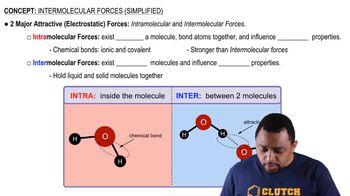
Intermolecular forces are the forces of attraction or repulsion between neighboring particles (atoms, molecules, or ions). They include hydrogen bonding, dipole-dipole interactions, and London dispersion forces. The strength of these forces significantly influences the physical properties of substances, such as boiling points, with stronger forces typically leading to higher boiling points.
Video consigliato:
Percorso guidato
01:59
Intermolecular vs Intramolecular Forces

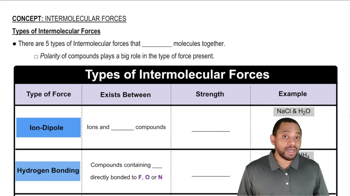
Types of Intermolecular Forces

Different substances exhibit various types of intermolecular forces. For example, hydrogen bonding occurs in molecules like water (H2O), while ionic compounds like sodium chloride (NaCl) exhibit ionic bonds. Understanding the type of intermolecular forces present in each substance is crucial for predicting their boiling points and ranking them accordingly.
Video consigliato:
Percorso guidato
06:44
Types of Intermolecular Forces

Boiling Point and Intermolecular Forces

The boiling point of a substance is the temperature at which its vapor pressure equals the external pressure, allowing it to transition from liquid to gas. Substances with stronger intermolecular forces require more energy to overcome these attractions, resulting in higher boiling points. Thus, analyzing the types and strengths of intermolecular forces helps in ranking substances based on their boiling points.
Video consigliato:
Percorso guidato
01:59
Intermolecular vs Intramolecular Forces