Of the substances Xe, CH3Cl, and HF, which has:
(a) The smallest dipole–dipole forces?
Guida verificata passo dopo passo
1
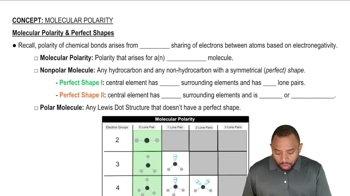
Identify the type of bonding and molecular polarity for each substance: Xe is a noble gas with no permanent dipole moment; CH3Cl (methyl chloride) is a polar molecule due to the difference in electronegativity between C-Cl and C-H bonds; HF (hydrogen fluoride) is also a polar molecule with a significant difference in electronegativity between H and F.
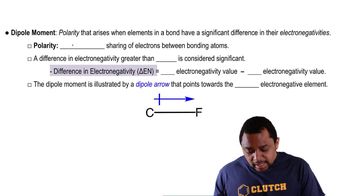
Understand that dipole-dipole forces occur between polar molecules where the positive end of one molecule is attracted to the negative end of another molecule.
Recognize that nonpolar molecules like Xe do not exhibit dipole-dipole forces because they lack a permanent dipole moment.
Compare the polarity of CH3Cl and HF. HF has a higher polarity due to the greater electronegativity difference between hydrogen and fluorine compared to the differences in CH3Cl.
Conclude that Xe, being nonpolar, has the smallest dipole-dipole forces among the given substances because it actually exhibits no dipole-dipole forces at all.
Risposta video verificata per un problema simile:
Questa soluzione video è stata consigliata dai nostri tutor come utile per risolvere questo problema.
Durata del video:
2m
Guarda un video:
0 Commenti
Concetti chiave
Ecco i concetti essenziali che devi comprendere per rispondere correttamente alla domanda.
Dipole-Dipole Interactions
Dipole-dipole interactions are attractive forces between the positive end of one polar molecule and the negative end of another. These forces arise due to the uneven distribution of electron density in polar molecules, leading to partial positive and negative charges. The strength of these interactions depends on the polarity of the molecules involved; more polar molecules exhibit stronger dipole-dipole forces.
Polarity refers to the distribution of electrical charge over the atoms in a molecule. A molecule is polar if it has a significant difference in electronegativity between its atoms, resulting in a dipole moment. In the context of the question, understanding the polarity of Xe, CH3Cl, and HF is crucial, as it directly influences the strength of their dipole-dipole interactions.
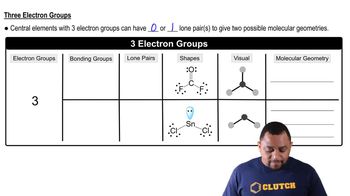
The molecular structure and geometry of a compound determine its polarity and, consequently, its intermolecular forces. For example, the shape of a molecule can affect how charge is distributed across it. In this question, analyzing the molecular geometry of Xe, CH3Cl, and HF helps predict which substance will have the weakest dipole-dipole forces based on their respective polarities and molecular arrangements.