Ch.11 - Liquids & Phase Changes
McMurry - Chemistry 8th Edition
McMurry8th EditionChemistryISBN: 9781292336145Non è quello che usi tu?Cambia libro di testo
Capitolo 11, Problema 70

Intermolecular forces are important in creating ordered arrangements in liquid crystals. What types of intermolecu- lar forces exist in a sample of the following compound? Chemical structure of a compound relevant to intermolecular forces in liquid crystals.

Guida verificata passo dopo passo
1
Identify the functional groups present in the compound. In this case, the compound has a benzene ring with a methoxy group (-OCH3), an amino group (-NH2), and a carboxylic acid group (-COOH).
Determine the types of intermolecular forces each functional group can participate in. The methoxy group can engage in dipole-dipole interactions and London dispersion forces. The amino group can participate in hydrogen bonding, dipole-dipole interactions, and London dispersion forces. The carboxylic acid group can engage in hydrogen bonding, dipole-dipole interactions, and London dispersion forces.
Consider the overall structure of the molecule and how these functional groups might interact with each other and with other molecules. The benzene ring can participate in π-π interactions, which are a type of London dispersion force.
Summarize the types of intermolecular forces present in the compound. These include hydrogen bonding (from the -NH2 and -COOH groups), dipole-dipole interactions (from the -OCH3, -NH2, and -COOH groups), London dispersion forces (from the entire molecule, including the benzene ring), and π-π interactions (from the benzene ring).
Conclude that the compound exhibits a combination of hydrogen bonding, dipole-dipole interactions, London dispersion forces, and π-π interactions, which contribute to the ordered arrangements in liquid crystals.

Risposta video verificata per un problema simile:

Questa soluzione video è stata consigliata dai nostri tutor come utile per risolvere questo problema.
Durata del video:
1m

Concetti chiave

Ecco i concetti essenziali che devi comprendere per rispondere correttamente alla domanda.

Intermolecular Forces

Intermolecular forces are the attractive forces between molecules that influence physical properties such as boiling and melting points. The main types include hydrogen bonding, dipole-dipole interactions, and London dispersion forces. Understanding these forces is crucial for analyzing the behavior of substances, particularly in states of matter like liquids and solids.
Video consigliato:
Percorso guidato
01:59
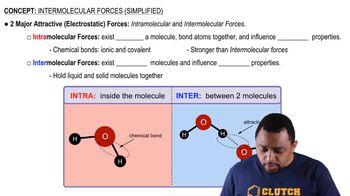
Intermolecular vs Intramolecular Forces

Hydrogen Bonding

Hydrogen bonding is a strong type of dipole-dipole interaction that occurs when hydrogen is covalently bonded to highly electronegative atoms like oxygen, nitrogen, or fluorine. In the compound shown, the presence of the -COOH (carboxylic acid) and -NH2 (amine) groups allows for significant hydrogen bonding, which contributes to the compound's solubility and structural properties in liquid crystals.
Video consigliato:
Percorso guidato
01:22
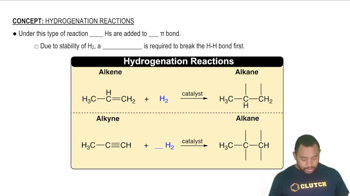
Hydrogenation Reactions

Liquid Crystals

Liquid crystals are materials that exhibit properties between those of liquids and solid crystals. They have ordered molecular arrangements that can change in response to temperature or electric fields. The intermolecular forces present in liquid crystals, such as hydrogen bonding and van der Waals forces, play a critical role in maintaining their unique phases and behaviors, making them essential in applications like displays and sensors.
Video consigliato:
Percorso guidato
03:04
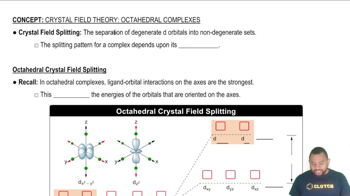
The crystal field splitting pattern for octahedral complexes has the d orbitals on or along the axes as having the higher energy.
Pratica correlata
Domanda del libro di testo

Two compounds (labeled I and II) have a liquid crystal state. Predict which compound has a higher temperature associ- ated with the solid to liquid crystal phase change. Explain your reasoning.

339
views

Domanda del libro di testo
The chlorofluorocarbon refrigerant trichlorofluoromethane, CCl3F, has Pvap = 100.0 mm Hg at -23 °C and ΔHvap = 24.77 kJ>mol. (b) What is ΔSvap for trichlorofluoromethane?
777
views
Domanda del libro di testo
Benzene has a melting point of 5.53 °C and a boiling point of 80.09 °C at atmospheric pressure. Its density is0.8787 g>cm3 when liquid and 0.899 g>cm3 when solid; it has Tc = 289.01 °C, Pc = 48.34 atm, Tt = 5.52 °C, and Pt = 0.0473 atm. Starting from a point at 200 K and 66.5 atm, trace the following path on a phase diagram. (1) First, increase T to 585 K while keeping P constant. (2) Next, decrease P to 38.5 atm while keeping T constant. (3) Then, decrease T to 278.66 K while keeping P constant. (4) Finally, decrease P to 0.0025 atm while keeping T constant. What is your starting phase, and what is your final phase?
2486
views
Domanda del libro di testo
The compound cholesteryl benzoate is a rod-like molecule that undergoes a phase change from the solid to the liq- uid crystal phase at 145.5 °C. When cholesteryl benzoate is mixed with cholesteryl oleyl carbonate, a molecule with a curved shape, the temperature of the solid to liquid crys- tal transition changes. Predict if the transition temperature increases or decreases and explain your reasoning.
754
views