
Ch.11 - Liquids & Phase Changes
McMurry - Chemistry 8th Edition
McMurry8th EditionChemistryISBN: 9781292336145Non è quello che usi tu?Cambia libro di testo
Capitolo 11, Problema 24

The chemical structure for oleic acid, the primary component of olive oil, is shown. Explain why olive oil has a higher vis- cosity than water.

Guida verificata passo dopo passo
1
Oleic acid is a long-chain fatty acid with the chemical formula C18H34O2, which means it has a long hydrocarbon chain.
The long hydrocarbon chain of oleic acid is nonpolar and interacts with other oleic acid molecules through van der Waals forces, which are relatively strong due to the large surface area of the molecules.
Water, on the other hand, is a small polar molecule (H2O) that forms hydrogen bonds with other water molecules. These hydrogen bonds are strong but occur between much smaller molecules.
The larger size and nonpolar nature of oleic acid molecules result in stronger intermolecular forces compared to the hydrogen bonds in water, leading to higher resistance to flow, or higher viscosity.
Therefore, the higher viscosity of olive oil compared to water is due to the larger size and stronger van der Waals interactions between oleic acid molecules.

Risposta video verificata per un problema simile:

Questa soluzione video è stata consigliata dai nostri tutor come utile per risolvere questo problema.
Durata del video:
2m

Concetti chiave

Ecco i concetti essenziali che devi comprendere per rispondere correttamente alla domanda.

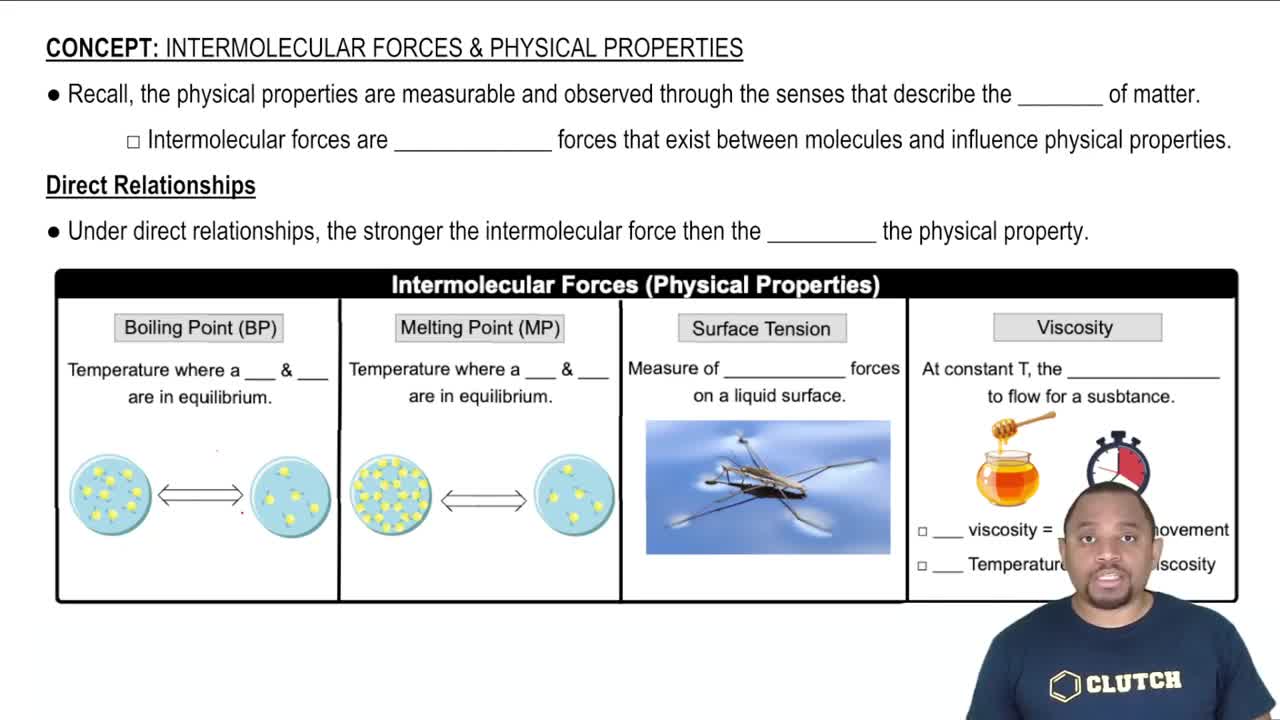
Viscosity

Viscosity is a measure of a fluid's resistance to flow. It is influenced by the interactions between molecules; higher viscosity indicates stronger intermolecular forces. In general, larger and more complex molecules, like those in olive oil, tend to have higher viscosities compared to smaller, simpler molecules like water.
Video consigliato:
Percorso guidato
03:13
Intermolecular Forces and Properties

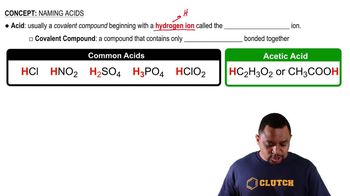
Molecular Structure of Oleic Acid

Oleic acid is a long-chain fatty acid with a hydrophobic tail and a hydrophilic carboxylic acid group. The long hydrocarbon chain contributes to its higher molecular weight and complexity, leading to increased van der Waals forces between molecules. This structural characteristic enhances the viscosity of olive oil compared to water, which has a simpler molecular structure.
Video consigliato:
Percorso guidato
02:15
Acids and Their Structure

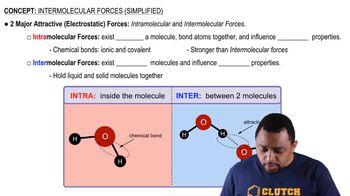
Intermolecular Forces

Intermolecular forces are the forces of attraction or repulsion between molecules. In olive oil, the presence of long hydrocarbon chains leads to stronger London dispersion forces, while water primarily exhibits hydrogen bonding. The stronger intermolecular forces in olive oil result in a higher viscosity compared to the relatively weaker forces in water.
Video consigliato:
Percorso guidato
01:59
Intermolecular vs Intramolecular Forces