Ch.11 - Liquids & Phase Changes
McMurry - Chemistry 8th Edition
McMurry8th EditionChemistryISBN: 9781292336145Non è quello che usi tu?Cambia libro di testo
Capitolo 11, Problema 25

The viscosity of water at 20 °C is 1.00 * 10-3 1N • s>m2 2 higher than dimethyl sulfide 31CH322 S4 2.8 * 10-4 1N • s>m2 2. Explain the difference in viscosity based on chemical structure.

Guida verificata passo dopo passo
1
Viscosity is a measure of a fluid's resistance to flow. It is influenced by the intermolecular forces present in the liquid.
Water (H2O) is a polar molecule with strong hydrogen bonding between its molecules. This hydrogen bonding significantly increases the viscosity of water.
Dimethyl sulfide ((CH3)2S) is a nonpolar molecule with weaker van der Waals forces (specifically London dispersion forces) between its molecules, resulting in lower viscosity.
The presence of hydrogen bonds in water creates a network of interactions that require more energy to overcome, leading to higher viscosity compared to dimethyl sulfide.
In summary, the difference in viscosity between water and dimethyl sulfide is primarily due to the strong hydrogen bonding in water, as opposed to the weaker intermolecular forces in dimethyl sulfide.

Risposta video verificata per un problema simile:

Questa soluzione video è stata consigliata dai nostri tutor come utile per risolvere questo problema.
Durata del video:
2m

Concetti chiave

Ecco i concetti essenziali che devi comprendere per rispondere correttamente alla domanda.

Viscosity

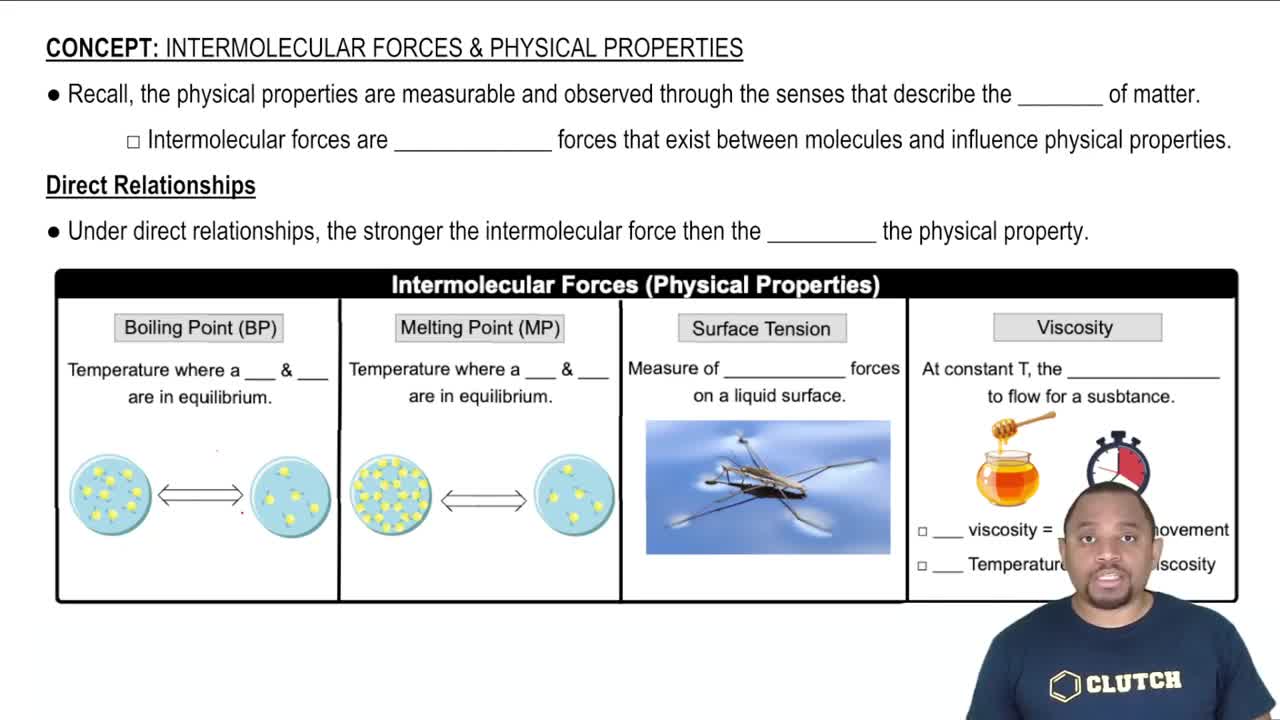
Viscosity is a measure of a fluid's resistance to flow, influenced by intermolecular forces and the size and shape of its molecules. Higher viscosity indicates a thicker fluid that flows more slowly, while lower viscosity corresponds to a thinner fluid that flows more easily. In the context of water and dimethyl sulfide, the differences in viscosity can be attributed to their molecular interactions and structural characteristics.
Video consigliato:
Percorso guidato
03:13
Intermolecular Forces and Properties

Intermolecular Forces

Intermolecular forces are the attractive forces between molecules that influence physical properties like boiling point, melting point, and viscosity. Water exhibits strong hydrogen bonding due to its polar nature, leading to higher viscosity. In contrast, dimethyl sulfide has weaker van der Waals forces, resulting in lower viscosity as its molecules can move past each other more easily.
Video consigliato:
Percorso guidato
01:59
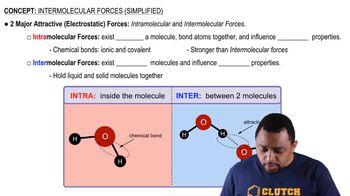
Intermolecular vs Intramolecular Forces

Molecular Structure

The molecular structure of a substance, including its shape and the presence of functional groups, significantly affects its physical properties. Water's bent shape and polar O-H bonds create a highly cohesive liquid, while dimethyl sulfide's linear structure and sulfur atom lead to less cohesive interactions. This structural difference contributes to the observed disparity in viscosity between the two substances.
Video consigliato:
Percorso guidato
02:08
Molecular Formula