Ch.12 - Solids and Solid-State Materials
McMurry - Chemistry 8th Edition
McMurry8th EditionChemistryISBN: 9781292336145Non è quello che usi tu?Cambia libro di testo
Capitolo 12, Problema 120

Silicon nitride 1Si3N42, a high-temperature ceramic useful for making engine components, is a covalent network solid in which each Si atom is bonded to four N atoms and each N atom is bonded to three Si atoms. Explain why silicon nitride is more brittle than a metal like copper.

Guida verificata passo dopo passo
1
Step 1: Understand the structure of silicon nitride and copper. Silicon nitride is a covalent network solid, meaning it is made up of a network of atoms connected by covalent bonds. In contrast, copper is a metal, which has a metallic bonding structure where the atoms are arranged in a lattice and electrons are free to move around.
Step 2: Consider the nature of the bonds in each material. Covalent bonds, like those in silicon nitride, are strong and directional, meaning they are not easily broken or rearranged. On the other hand, metallic bonds, like those in copper, are non-directional and allow for the atoms to slide past each other without breaking the bonds.
Step 3: Relate the bond types to the properties of the materials. The strong, directional covalent bonds in silicon nitride make it hard and rigid, but also brittle, meaning it can break or shatter under stress. In contrast, the non-directional metallic bonds in copper allow it to deform under stress without breaking, making it more ductile and less brittle.
Step 4: Conclude that the difference in brittleness between silicon nitride and copper is due to the difference in their bonding structures and the nature of their bonds.

Risposta video verificata per un problema simile:

Questa soluzione video è stata consigliata dai nostri tutor come utile per risolvere questo problema.
Durata del video:
3m

Concetti chiave

Ecco i concetti essenziali che devi comprendere per rispondere correttamente alla domanda.

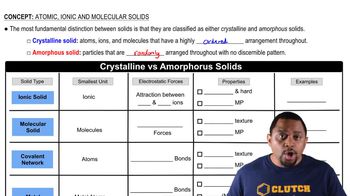
Covalent Network Solids

Covalent network solids, like silicon nitride, consist of a continuous network of covalent bonds, creating a rigid structure. This extensive bonding leads to high melting points and hardness but also results in brittleness, as the strong bonds do not allow for easy deformation. When stress is applied, these materials tend to fracture rather than bend.
Video consigliato:
Percorso guidato
04:13
Crystalline vs Amorphous Solids

Metallic Bonding

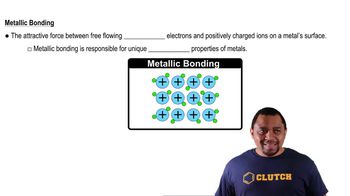
In metals like copper, atoms are held together by metallic bonds, which involve a 'sea of electrons' that are free to move. This electron mobility allows metals to deform plastically under stress, making them malleable and ductile. The ability to absorb energy through deformation contributes to the toughness of metals compared to covalent network solids.
Video consigliato:

Brittleness vs. Ductility

Brittleness refers to a material's tendency to break or shatter under stress without significant deformation, while ductility is the ability to stretch or deform without breaking. Silicon nitride's strong covalent bonds contribute to its brittleness, as it cannot undergo plastic deformation like ductile metals, which can absorb and redistribute stress through movement of dislocations.
Video consigliato:
Percorso guidato
03:05
Ksp vs Q in Precipitation