
Ch.13 - Solutions & Their Properties
McMurry - Chemistry 8th Edition
McMurry8th EditionChemistryISBN: 9781292336145Non è quello che usi tu?Cambia libro di testo
Capitolo 13, Problema 9

A scuba diver is breathing compressed air that is 21% (by volume) oxygen at a depth of 66 ft. beneath the surface. The total pressure at this depth is 3.0 atm. The Henry's law constant (k) for O2 in water at a normal body temperature (37 °C ) is 1.93 * 10-3 mol>(L atm). What is the solubility of O2 in the blood of the diver at 66 ft. beneath the surface? (LO 13.9) (a) 1.22 * 10-3 M (b) 2.76 * 10-2 M (c) 1.22 * 10-1 M (d) 2.76 * 10-1 M

Guida verificata passo dopo passo
1
Step 1: Identify the given information. The total pressure at the depth of 66 ft is 3.0 atm. The volume fraction of oxygen in the air is 21%. The Henry's law constant for O2 in water at 37 °C is 1.93 * 10^-3 mol/(L atm).
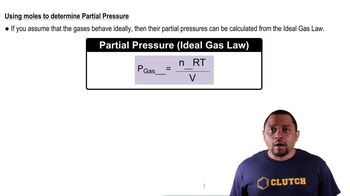
Step 2: Calculate the partial pressure of oxygen at the given depth. According to Dalton's law of partial pressures, the partial pressure of a gas is equal to the total pressure times the volume fraction of the gas. In this case, the partial pressure of oxygen is 0.21 * 3.0 atm.
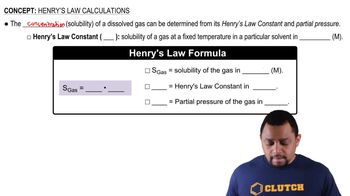
Step 3: Use Henry's law to calculate the solubility of oxygen in the blood. According to Henry's law, the solubility of a gas in a liquid is directly proportional to the partial pressure of the gas above the liquid. The formula for Henry's law is S = kP, where S is the solubility, k is the Henry's law constant, and P is the partial pressure of the gas.
Step 4: Substitute the values into the Henry's law equation. The solubility of oxygen in the blood is equal to the Henry's law constant times the partial pressure of oxygen.
Step 5: Compare your calculated solubility with the options given in the problem to find the correct answer.

Risposta video verificata per un problema simile:

Questa soluzione video è stata consigliata dai nostri tutor come utile per risolvere questo problema.
Durata del video:
1m

Concetti chiave

Ecco i concetti essenziali che devi comprendere per rispondere correttamente alla domanda.

Henry's Law

Henry's Law states that the amount of gas that dissolves in a liquid is directly proportional to the partial pressure of that gas above the liquid. This relationship can be expressed mathematically as C = kP, where C is the concentration of the gas in the liquid, k is the Henry's law constant, and P is the partial pressure of the gas. Understanding this law is crucial for calculating the solubility of gases in liquids, such as oxygen in blood.
Video consigliato:
Percorso guidato
01:40
Henry's Law Calculations

Partial Pressure

Partial pressure is the pressure exerted by a single component of a gas mixture. In the context of the scuba diver, the total pressure at a depth of 66 ft is 3.0 atm, and the partial pressure of oxygen can be calculated by multiplying the total pressure by the fraction of oxygen in the air (21%). This concept is essential for determining how much oxygen is available for dissolution in the diver's blood.
Video consigliato:
Percorso guidato
00:48
Partial Pressure Calculation

Gas Solubility in Blood

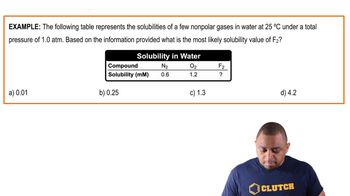
The solubility of gases in blood is influenced by factors such as temperature, pressure, and the specific gas involved. For oxygen, its solubility can be calculated using Henry's Law, taking into account the partial pressure of oxygen and the Henry's law constant for oxygen in blood. This concept is vital for understanding how oxygen is transported in the body, especially under varying pressure conditions experienced by divers.
Video consigliato:
Percorso guidato
01:44
Gas Solubility Example