
Ch.13 - Solutions & Their Properties
McMurry - Chemistry 8th Edition
McMurry8th EditionChemistryISBN: 9781292336145Non è quello che usi tu?Cambia libro di testo
Capitolo 13, Problema 12

12. A solution contains 4.08 g of chloroform 1CHCl32 and 9.29 g of acetone 1CH3COCH32. The vapor pressures at 35 °C of pure chloroform and pure acetone are 295 torr and 332 torr, respectively. Assuming ideal behavior, calculate the vapor pressure above the solution. (LO 13.12) (a) 256 torr (b) 314 torr (c) 325 torr (d) 462 torr

Guida verificata passo dopo passo
1
Calculate the moles of chloroform (CHCl_3) using its molar mass.
Calculate the moles of acetone (CH_3COCH_3) using its molar mass.
Determine the mole fraction of chloroform by dividing the moles of chloroform by the total moles of both substances.
Determine the mole fraction of acetone by dividing the moles of acetone by the total moles of both substances.
Use Raoult's Law to calculate the total vapor pressure: P_total = (X_chloroform * P_chloroform) + (X_acetone * P_acetone), where X is the mole fraction and P is the vapor pressure of the pure component.

Risposta video verificata per un problema simile:

Questa soluzione video è stata consigliata dai nostri tutor come utile per risolvere questo problema.
Durata del video:
4m

Concetti chiave

Ecco i concetti essenziali che devi comprendere per rispondere correttamente alla domanda.

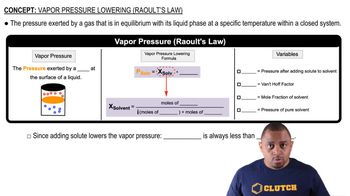
Raoult's Law

Raoult's Law states that the vapor pressure of a solvent in a solution is directly proportional to the mole fraction of the solvent in the solution. This principle is essential for calculating the vapor pressure of a solution, as it allows us to determine how the presence of a solute affects the overall vapor pressure compared to that of the pure solvent.
Video consigliato:
Percorso guidato
02:40
Raoult's Law and Vapor Pressure

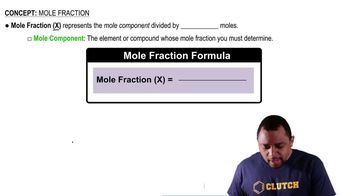
Mole Fraction

Mole fraction is a way of expressing the concentration of a component in a mixture, defined as the number of moles of that component divided by the total number of moles of all components in the mixture. In this problem, calculating the mole fractions of chloroform and acetone is crucial for applying Raoult's Law to find the vapor pressure of the solution.
Video consigliato:
Percorso guidato
00:36
Mole Fraction Formula

Ideal Solution Behavior

An ideal solution is one where the interactions between different molecules are similar to those between like molecules, leading to predictable behavior according to Raoult's Law. This assumption simplifies calculations, as it allows us to use the pure component vapor pressures and mole fractions to determine the vapor pressure of the solution without accounting for deviations due to intermolecular forces.
Video consigliato:
Percorso guidato
01:15
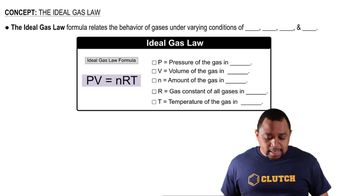
Ideal Gas Law Formula
Pratica correlata
Domanda del libro di testo
Which of the following solutions has the lowest vapor pres- sure? (Assume complete dissociation for ionic compounds.) (LO 13.10) (a) An aqueous solution of 0.25 m Ca1NO322 (b) An aqueous solution of 0.30 m sodium chloride (NaCl) (c) A mixture of 50 mL of water and 50 mL of ethanol 1CH3CH2OH2 (d) A mixture of 25 mL of water and 50 mL of ethanol 1CH3CH2OH2
629
views
Domanda del libro di testo
How many kilograms of ethylene glycol (automobile anti- freeze, C2H6O2) dissolved in 3.55 kg of water are needed to lower the freezing point of water in an automobile radiator to - 22.0 °C? The molal freezing point depression constant for water is Kf = 1.86 1°C kg2>mol. (LO 13.13) (a) 0.865 kg (b) 0.0420 kg (c) 9.01 kg (d) 2.61 kg
438
views
Domanda del libro di testo
A scuba diver is breathing compressed air that is 21% (by volume) oxygen at a depth of 66 ft. beneath the surface. The total pressure at this depth is 3.0 atm. The Henry's law constant (k) for O2 in water at a normal body temperature (37 °C ) is 1.93 * 10-3 mol>(L atm). What is the solubility of O2 in the blood of the diver at 66 ft. beneath the surface? (LO 13.9) (a) 1.22 * 10-3 M (b) 2.76 * 10-2 M (c) 1.22 * 10-1 M (d) 2.76 * 10-1 M
799
views
Domanda del libro di testo
Hemoglobin is a large molecule that carries oxygen in the body. An aqueous solution that contains 2.61 g of hemoglo- bin in 100.0 mL has an osmotic pressure of 7.52 mmHg at 25 °C. What is the molar mass of the hemoglobin? Assume hemoglobin does not dissociate in water. (LO 13.15) (a) 1.96 * 103 g>mol (b) 84.8 g/mol (c) 6.45 * 104 g>mol (d) 3.65 * 103 g>mol
974
views