
Ch.13 - Solutions & Their Properties
McMurry - Chemistry 8th Edition
McMurry8th EditionChemistryISBN: 9781292336145Non è quello che usi tu?Cambia libro di testo
Capitolo 13, Problema 44

Br₂ is much more soluble in tetrachloromethane (CCl₄) than in water. Explain.

Guida verificata passo dopo passo
1
Step 1: Understand the nature of the solute and solvents involved. Bromine (Br₂) is a nonpolar molecule, while tetrachloromethane (CCl₄) is also nonpolar. Water, on the other hand, is a polar solvent.
Step 2: Recall the principle 'like dissolves like,' which means that nonpolar solutes tend to dissolve well in nonpolar solvents, and polar solutes dissolve well in polar solvents.
Step 3: Analyze the interactions. In a nonpolar solvent like CCl₄, Br₂ molecules can interact through London dispersion forces, which are weak intermolecular forces that occur between nonpolar molecules.
Step 4: Consider the interactions in water. Water molecules are polar and can form hydrogen bonds, which are strong intermolecular forces. Br₂, being nonpolar, cannot effectively interact with water molecules, leading to poor solubility.
Step 5: Conclude that the solubility of Br₂ in CCl₄ is higher than in water because the nonpolar Br₂ molecules are more compatible with the nonpolar CCl₄, allowing for better solvation through dispersion forces.

Concetti chiave

Ecco i concetti essenziali che devi comprendere per rispondere correttamente alla domanda.

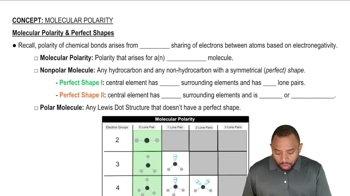
Polarity of Solvents

Solubility is greatly influenced by the polarity of solvents. Water is a polar solvent, meaning it has a significant dipole moment due to its molecular structure, which allows it to interact well with other polar substances. In contrast, tetrachloromethane (CCl₄) is a nonpolar solvent, which interacts more effectively with nonpolar solutes like Br₂, leading to higher solubility.
Video consigliato:
Percorso guidato
02:38
Molecular Polarity

Like Dissolves Like Principle

The principle of 'like dissolves like' states that polar solvents dissolve polar solutes, while nonpolar solvents dissolve nonpolar solutes. Since Br₂ is a nonpolar molecule, it is more soluble in nonpolar solvents like CCl₄ than in polar solvents like water. This principle helps predict solubility behavior based on the nature of the solute and solvent.
Video consigliato:
Percorso guidato
02:05
Uncertainty Principle Formula

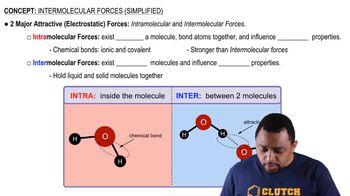
Intermolecular Forces

Intermolecular forces play a crucial role in solubility. In water, hydrogen bonding and dipole-dipole interactions dominate, which do not favor the dissolution of nonpolar substances like Br₂. In CCl₄, the weak London dispersion forces allow for better interaction with Br₂, facilitating its solubility in the nonpolar environment.
Video consigliato:
Percorso guidato
01:59
Intermolecular vs Intramolecular Forces