Ch.13 - Solutions & Their Properties
McMurry - Chemistry 8th Edition
McMurry8th EditionChemistryISBN: 9781292336145Non è quello che usi tu?Cambia libro di testo
Capitolo 13, Problema 5

Fluoride ion is added to drinking water at low concentra- tions to prevent tooth decay. What mass of sodium fluoride (NaF) should be added to 750 L of water to make a solution that is 1.5 ppm in fluoride ion? (LO 13.5) (a) 1.1 g (b) 2.5 g (c) 0.51 g (d) 3.1 g

Guida verificata passo dopo passo
1
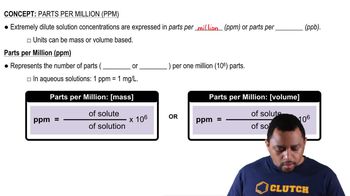
Determine the total mass of fluoride ions needed. Since the concentration desired is 1.5 ppm (parts per million), this means 1.5 mg of fluoride ion per liter of water. Multiply this concentration by the total volume of water (750 L) to find the total mass of fluoride ions required in milligrams.
Convert the mass of fluoride ions from milligrams to grams because the mass of sodium fluoride (NaF) will need to be calculated in grams. Remember that 1000 mg equals 1 g.
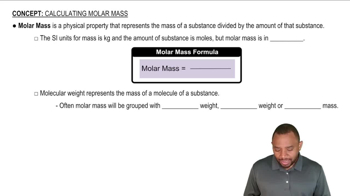
Calculate the molar mass of fluoride ion (F-) and sodium fluoride (NaF). Use the periodic table to find the atomic masses of sodium (Na) and fluorine (F), then add them together to get the molar mass of NaF.
Determine how many moles of fluoride ion are present in the required mass of fluoride ions using the molar mass of fluoride ion.
Calculate the mass of sodium fluoride (NaF) needed by using the stoichiometry of the compound. Since each mole of NaF provides one mole of fluoride ion, the moles of NaF needed will be equal to the moles of fluoride ions calculated. Multiply the moles of NaF by its molar mass to find the required mass of NaF in grams.

Risposta video verificata per un problema simile:

Questa soluzione video è stata consigliata dai nostri tutor come utile per risolvere questo problema.
Durata del video:
3m

Concetti chiave

Ecco i concetti essenziali che devi comprendere per rispondere correttamente alla domanda.

Parts Per Million (ppm)

Parts per million (ppm) is a unit of measurement that expresses the concentration of a substance in a solution. It indicates how many parts of a solute are present in one million parts of the solution. For example, a concentration of 1.5 ppm means there are 1.5 grams of solute in one million grams of solution, which is crucial for calculating the required mass of sodium fluoride in this context.
Video consigliato:
Percorso guidato
01:38
Parts per Million (ppm)

Molar Mass and Stoichiometry

Understanding molar mass is essential for converting between grams and moles of a substance. Sodium fluoride (NaF) has a molar mass of approximately 42 g/mol. Stoichiometry allows us to relate the mass of NaF needed to achieve the desired fluoride ion concentration in the water, enabling accurate calculations based on the ppm value.
Video consigliato:
Percorso guidato
02:11
Molar Mass Concept

Dilution and Solution Preparation

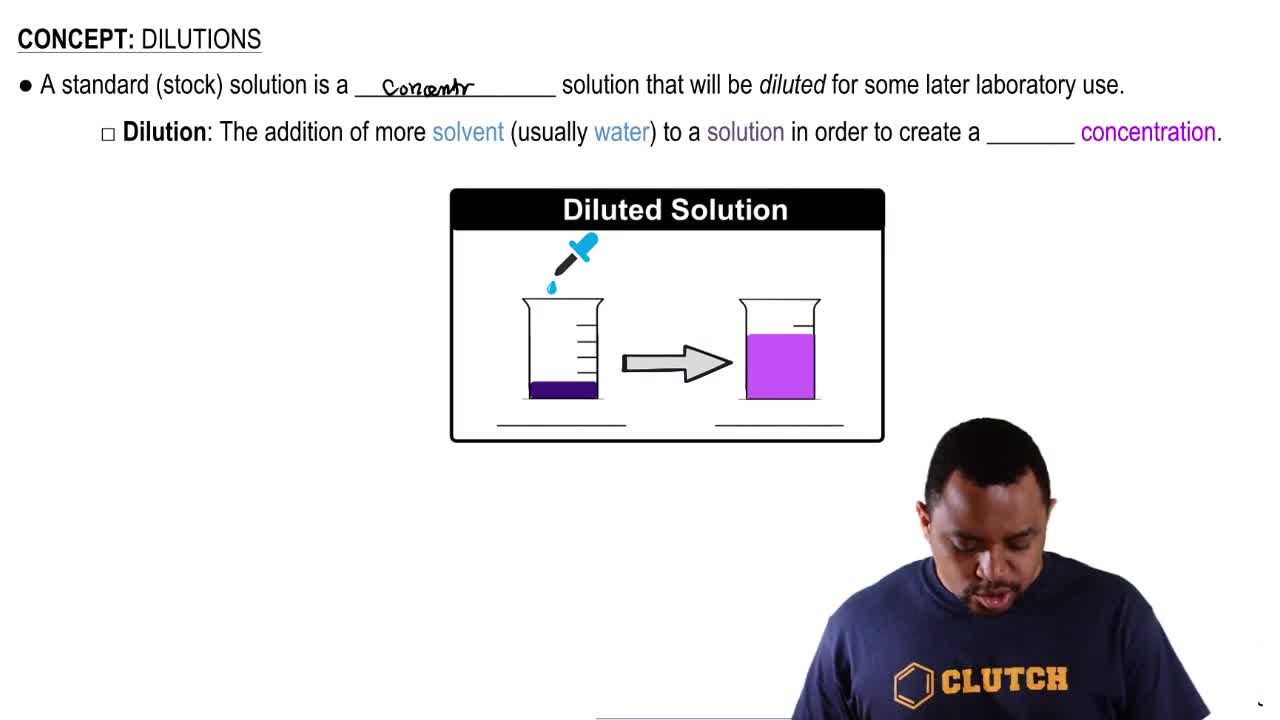
Dilution is the process of reducing the concentration of a solute in a solution, typically by adding more solvent. In this case, knowing the volume of water (750 L) and the desired concentration (1.5 ppm) allows us to calculate the total mass of fluoride needed and subsequently determine how much sodium fluoride must be added to achieve that concentration in the water.
Video consigliato:
Percorso guidato
01:03
Solution Dilution Process