Ch.13 - Solutions & Their Properties
McMurry - Chemistry 8th Edition
McMurry8th EditionChemistryISBN: 9781292336145Non è quello che usi tu?Cambia libro di testo
Capitolo 13, Problema 2

When lithium chloride dissolves in water, the temperature of the solution increases. Which diagram represents the enthalpy changes of the steps in the solution-making process? (LO 13.2)

Guida verificata passo dopo passo
1
Identify the process of dissolving lithium chloride in water as an exothermic reaction, where the temperature of the solution increases.
Understand that the enthalpy change of solution (ΔH_solution) can be broken down into three steps: breaking the lattice of the solute (endothermic), breaking the hydrogen bonds of the solvent (endothermic), and forming new interactions between solute and solvent (exothermic).
Recognize that the overall enthalpy change (ΔH_solution) is the sum of the enthalpy changes of these steps: ΔH_lattice (endothermic) + ΔH_hydration (exothermic).
Since the temperature increases, the exothermic process (ΔH_hydration) must be greater in magnitude than the endothermic process (ΔH_lattice), resulting in a negative ΔH_solution.
Visualize a diagram where the initial energy level (lattice energy) is higher, followed by a rise (endothermic step), and then a larger drop (exothermic step) to a final energy level lower than the initial, indicating an overall exothermic process.

Risposta video verificata per un problema simile:

Questa soluzione video è stata consigliata dai nostri tutor come utile per risolvere questo problema.
Durata del video:
4m

Concetti chiave

Ecco i concetti essenziali che devi comprendere per rispondere correttamente alla domanda.

Enthalpy of Solution

The enthalpy of solution refers to the heat change that occurs when a solute dissolves in a solvent. It can be either exothermic, where heat is released (as in the case of lithium chloride in water), or endothermic, where heat is absorbed. Understanding this concept is crucial for analyzing temperature changes during dissolution.
Video consigliato:
Percorso guidato
02:34
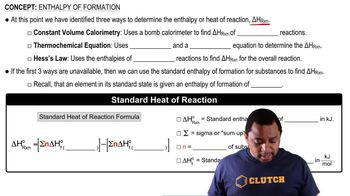
Enthalpy of Formation

Endothermic vs. Exothermic Processes

Endothermic processes absorb heat from the surroundings, leading to a decrease in temperature, while exothermic processes release heat, causing an increase in temperature. In the context of lithium chloride dissolving in water, the exothermic nature of the process results in a temperature rise, which is essential for interpreting the enthalpy changes involved.
Video consigliato:
Percorso guidato
1:48
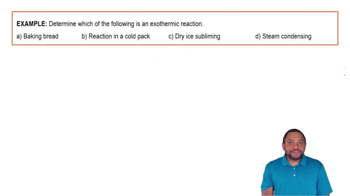
Endothermic & Exothermic Reactions Example 2

Thermodynamic Diagrams

Thermodynamic diagrams, such as enthalpy change diagrams, visually represent the energy changes during a chemical process. They typically illustrate the steps of dissolution, including the breaking of ionic bonds in the solute and the formation of solute-solvent interactions. Understanding how to read these diagrams is vital for identifying the enthalpy changes associated with the dissolution of lithium chloride.
Video consigliato:
Percorso guidato
01:18
First Law of Thermodynamics