Ch.13 - Solutions & Their Properties
McMurry - Chemistry 8th Edition
McMurry8th EditionChemistryISBN: 9781292336145Non è quello che usi tu?Cambia libro di testo
Capitolo 13, Problema 79

Lactose, C12H22O11, is a naturally occurring sugar found in mammalian milk. A 0.335 M solution of lactose in water has a density of 1.0432 g/L at 20 °C. What is the concentra- tion of this solution in the following units? (b) Mass percent

Guida verificata passo dopo passo
1
Calculate the mass of lactose in 1 liter of solution. Use the molarity of the solution (0.335 M) which means there are 0.335 moles of lactose per liter. Multiply the number of moles by the molar mass of lactose (C12H22O11), which is approximately 342 g/mol.
Calculate the total mass of the solution. Since the density of the solution is 1.0432 g/mL, and there are 1000 mL in a liter, multiply the density by 1000 to find the mass of 1 liter of solution.
Determine the mass of lactose in grams per liter from step 1 and add this to the mass of water to confirm it matches the total mass calculated in step 2. This step serves as a check.
Calculate the mass percent of lactose in the solution. The mass percent is given by the formula: (mass of solute / mass of solution) x 100%. Use the mass of lactose from step 1 and the total mass of the solution from step 2.
Express the final result as a percentage to find the mass percent concentration of lactose in the solution.

Risposta video verificata per un problema simile:

Questa soluzione video è stata consigliata dai nostri tutor come utile per risolvere questo problema.
Durata del video:
3m

Concetti chiave

Ecco i concetti essenziali che devi comprendere per rispondere correttamente alla domanda.

Molarity

Molarity (M) is a measure of concentration defined as the number of moles of solute per liter of solution. In this case, a 0.335 M solution of lactose indicates that there are 0.335 moles of lactose in every liter of the solution. Understanding molarity is essential for converting between different concentration units, such as mass percent.
Video consigliato:

Density

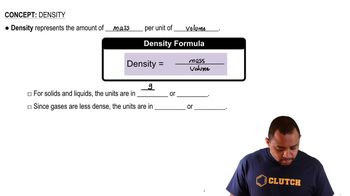
Density is the mass of a substance per unit volume, typically expressed in grams per liter (g/L) or grams per cubic centimeter (g/cm³). The density of the lactose solution at 1.0432 g/L is crucial for calculating the mass of the solution, which is necessary for determining mass percent. It allows us to relate the volume of the solution to its total mass.
Video consigliato:
Percorso guidato
01:56
Density Concepts

Mass Percent

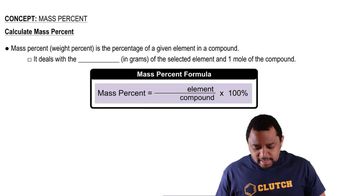
Mass percent is a way of expressing the concentration of a component in a mixture, calculated as the mass of the solute divided by the total mass of the solution, multiplied by 100. To find the mass percent of lactose in the solution, one must first determine the mass of lactose and the total mass of the solution using the molarity and density values provided.
Video consigliato:
Percorso guidato
00:38
Mass Percent Calculation