
Ch.13 - Solutions & Their Properties
McMurry - Chemistry 8th Edition
McMurry8th EditionChemistryISBN: 9781292336145Non è quello che usi tu?Cambia libro di testo
Capitolo 13, Problema 54

The dissolution of CaCl2(s) in water is exothermic, with ΔHsoln= - 81.3 kJ>mol. If you were to prepare a 1.00 m solution of CaCl2 beginning with water at 25.0 °C, what would the final temperature of the solution be in °C? Assume that the specific heats of both pure H2O and the solution are the same, 4.18 J>1K g2.

Guida verificata passo dopo passo
1
First, we need to understand that the dissolution of CaCl2 in water is an exothermic process, meaning it releases heat. The heat released will raise the temperature of the solution.
Next, we need to calculate the amount of heat released during the dissolution process. We can use the formula q = m * c * ΔT, where q is the heat, m is the mass, c is the specific heat, and ΔT is the change in temperature. In this case, we know that the heat released (q) is equal to ΔHsoln, the enthalpy of solution, which is -81.3 kJ/mol. We also know that the specific heat (c) is 4.18 J/1K g2.
Since we are preparing a 1.00 m solution of CaCl2, we know that there is 1 mol of CaCl2 in 1 kg of water. Therefore, the mass (m) of the solution is 1000 g.
Substitute the known values into the formula q = m * c * ΔT. Remember to convert the enthalpy of solution from kJ to J by multiplying by 1000, because the specific heat is given in J. Solve for ΔT, the change in temperature.
Finally, add the change in temperature (ΔT) to the initial temperature of the water (25.0 °C) to find the final temperature of the solution.

Risposta video verificata per un problema simile:

Questa soluzione video è stata consigliata dai nostri tutor come utile per risolvere questo problema.
Durata del video:
4m

Concetti chiave

Ecco i concetti essenziali che devi comprendere per rispondere correttamente alla domanda.

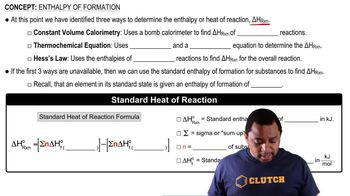
Enthalpy of Solution (ΔHsoln)

The enthalpy of solution, ΔHsoln, refers to the heat change associated with the dissolution of a solute in a solvent. In this case, the dissolution of CaCl2 is exothermic, meaning it releases heat, which is indicated by a negative ΔHsoln value of -81.3 kJ/mol. This concept is crucial for understanding how the temperature of the solution changes as the solute dissolves.
Video consigliato:
Percorso guidato
02:34
Enthalpy of Formation

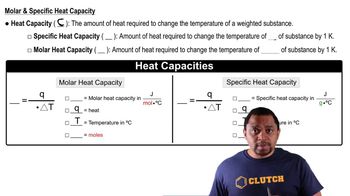
Specific Heat Capacity

Specific heat capacity is the amount of heat required to raise the temperature of a unit mass of a substance by one degree Celsius (or Kelvin). For this problem, it is given that the specific heat of both pure water and the resulting solution is 4.18 J/g·K. This property is essential for calculating the temperature change of the solution after the dissolution process.
Video consigliato:

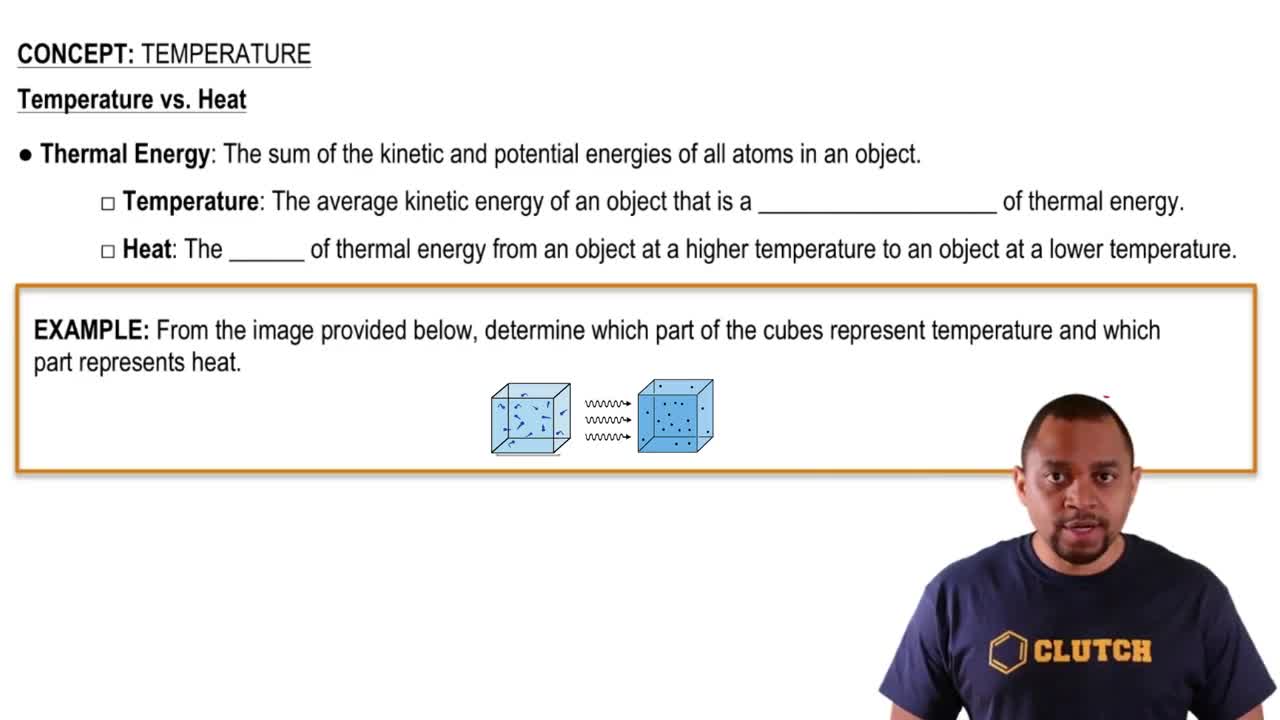
Heat Transfer and Temperature Change

Heat transfer during a chemical process, such as dissolution, affects the temperature of the system. The heat released by the dissolution of CaCl2 will increase the temperature of the water. By applying the formula q = mcΔT, where q is the heat absorbed or released, m is the mass, c is the specific heat, and ΔT is the change in temperature, one can determine the final temperature of the solution after the dissolution.
Video consigliato:
Percorso guidato
03:48
Temperature vs Heat