What is the osmotic pressure in atmospheres you would expect for each of the following solutions? (a) 5.00 g of NaCl in 350.0 mL of aqueous solution at 50 °C (b) 6.33 g of sodium acetate, CH3CO2Na, in 55.0 mL of aqueous solution at 10 °C
Guida verificata passo dopo passo
1
Step 1: Calculate the molarity of the solution. First, determine the number of moles of solute. For NaCl, use its molar mass to convert grams to moles. Similarly, do this for sodium acetate, CH3CO2Na.
Step 2: Convert the volume of the solution from milliliters to liters, as molarity is expressed in moles per liter.
Step 3: Use the formula for molarity (M = moles of solute / liters of solution) to find the molarity of each solution.
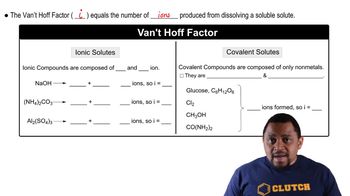
Step 4: Apply the formula for osmotic pressure: \( \Pi = iMRT \), where \( i \) is the van 't Hoff factor (2 for NaCl and 1 for sodium acetate), \( M \) is the molarity, \( R \) is the ideal gas constant (0.0821 L·atm/mol·K), and \( T \) is the temperature in Kelvin.
Step 5: Convert the given temperatures from Celsius to Kelvin by adding 273.15, then substitute all known values into the osmotic pressure formula to calculate the osmotic pressure for each solution.
Concetti chiave
Ecco i concetti essenziali che devi comprendere per rispondere correttamente alla domanda.
Osmotic Pressure
Osmotic pressure is the pressure required to prevent the flow of solvent into a solution through a semipermeable membrane. It is directly proportional to the concentration of solute particles in the solution, as described by the formula π = iCRT, where π is osmotic pressure, i is the van 't Hoff factor (number of particles the solute dissociates into), C is the molarity of the solution, R is the ideal gas constant, and T is the temperature in Kelvin.
The van 't Hoff factor (i) indicates the number of particles into which a solute dissociates in solution. For example, NaCl dissociates into two ions (Na⁺ and Cl⁻), so its van 't Hoff factor is 2. Understanding this factor is crucial for calculating osmotic pressure, as it affects the effective concentration of solute particles in the solution.
Molarity (C) is defined as the number of moles of solute per liter of solution. It is essential to calculate the concentration of the solute in the given volume of solution. Additionally, temperature affects the osmotic pressure, as it is included in the formula (T in Kelvin). Therefore, converting Celsius to Kelvin and accurately determining molarity are key steps in solving osmotic pressure problems.


 Guida verificata passo dopo passo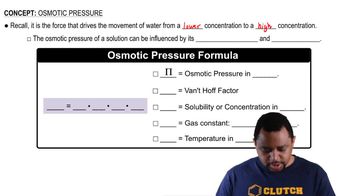
 01:13
01:13