Ch.14 - Chemical Kinetics
McMurry - Chemistry 8th Edition
McMurry8th EditionChemistryISBN: 9781292336145Non è quello che usi tu?Cambia libro di testo
Capitolo 14, Problema 48d

Consider a reaction that occurs by the following mechanism:
A + BC → AC + B
AC + D → A + CD
The potential energy profile for this reaction is as follows:
(d) Is the reaction endothermic or exothermic? Add labels to the diagram that show the values of the energy of reaction ΔE and the activation energy Ea for the overall reaction.

Guida verificata passo dopo passo
1
Identify the overall reaction by combining the two given elementary steps: A + BC + D → CD + B.
Determine the enthalpy change (ΔE) for the overall reaction by comparing the energy of the reactants and products. If the products have lower energy than the reactants, the reaction is exothermic; if higher, it is endothermic.
Locate the activation energy (Ea) on the potential energy diagram. This is the energy difference between the reactants and the highest point on the energy profile (the transition state).
Label the potential energy diagram with ΔE, showing the difference in energy between reactants and products, and Ea, showing the energy required to reach the transition state from the reactants.
Conclude whether the reaction is endothermic or exothermic based on the sign of ΔE: negative ΔE indicates exothermic, while positive ΔE indicates endothermic.

Risposta video verificata per un problema simile:

Questa soluzione video è stata consigliata dai nostri tutor come utile per risolvere questo problema.
Durata del video:
3m

Concetti chiave

Ecco i concetti essenziali che devi comprendere per rispondere correttamente alla domanda.

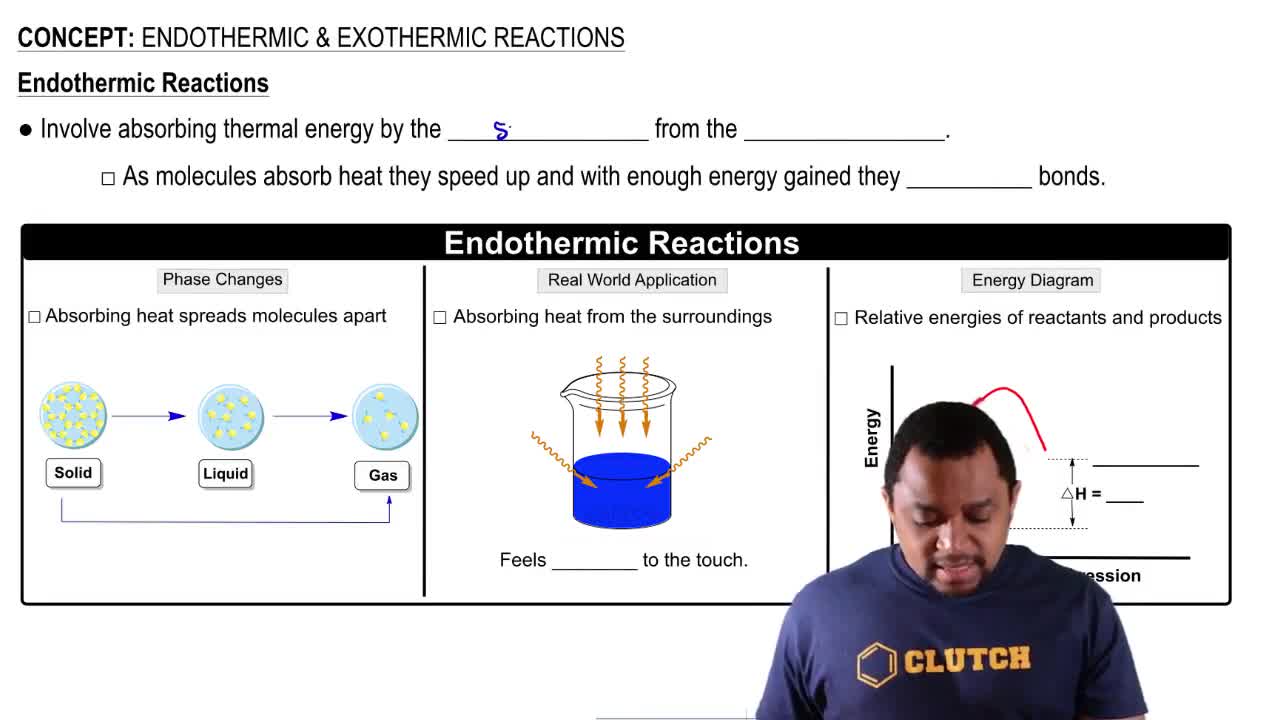
Endothermic and Exothermic Reactions

Endothermic reactions absorb energy from their surroundings, resulting in a net increase in the system's energy. Conversely, exothermic reactions release energy, leading to a net decrease in energy. The sign of the change in enthalpy (ΔH) indicates the type of reaction: positive for endothermic and negative for exothermic.
Video consigliato:
Percorso guidato
02:30
Endothermic & Exothermic Reactions

Activation Energy (Ea)

Activation energy is the minimum energy required for a chemical reaction to occur. It represents the energy barrier that reactants must overcome to transform into products. In a potential energy profile, Ea is depicted as the difference in energy between the reactants and the highest point of the energy barrier (transition state).
Video consigliato:
Percorso guidato
02:02
Activity Series Chart

Energy of Reaction (ΔE)

The energy of reaction (ΔE) is the difference in energy between the reactants and the products. It indicates whether the overall reaction is endothermic or exothermic. A negative ΔE signifies that the products have lower energy than the reactants, indicating an exothermic reaction, while a positive ΔE indicates an endothermic reaction.
Video consigliato:
Percorso guidato
01:51
Gibbs Free Energy of Reactions
Pratica correlata
Domanda del libro di testo
The relative rates of the reaction A + B S AB in vessels (1)–(3) are 4:4:1. Red spheres represent A molecules, and blue spheres represent B molecules. (1)-(3)

(a) What is the order of the reaction in A and B?
510
views

Domanda del libro di testo
Draw a plausible transition state for the bimolecular reaction of nitric oxide with ozone. Use dashed lines to indicate the atoms that are weakly linked together in the transition state. NO(g) + O3(g) NO2(g) + O2(g)

543
views
Domanda del libro di testo

From the plot of concentration–time data in Figure 14.1, estimate: (a) the instantaneous rate of decomposition of N2O5 at t = 200 s.

391
views
Domanda del libro di testo

Consider a reaction that occurs by the following mechanism:

A + BC → AC + B

AC + D → A + CD

The potential energy profile for this reaction is as follows:

(b) Write structural formulas for all species present at reaction stages 1–5. Identify each species as a reactant, product, catalyst, intermediate, or transition state.

685
views
Domanda del libro di testo

Consider a reaction that occurs by the following mechanism:

A + BC → AC + B

AC + D → A + CD

The potential energy profile for this reaction is as follows:

(c) Which of the two steps in the mechanism is the rate-determining step? Write the rate law for the overall reaction.

354
views
Domanda del libro di testo
Use the information in Table 14.1 and Figure 14.1 to estimate the instantaneous rate of appearance of NO2 at t = 350 s by calculating the average rate of appearance of NO2 over the following time intervals centered on t = 350 s. (a) 0 to 700 s (b) 100 to 600 s (c) 200 to 500 s (d) 300 to 400 s Which is the best estimate, and why?
684
views