Ch.14 - Chemical Kinetics
McMurry - Chemistry 8th Edition
McMurry8th EditionChemistryISBN: 9781292336145Non è quello che usi tu?Cambia libro di testo
Capitolo 14, Problema 48b

Consider a reaction that occurs by the following mechanism:
A + BC → AC + B
AC + D → A + CD
The potential energy profile for this reaction is as follows:
(b) Write structural formulas for all species present at reaction stages 1–5. Identify each species as a reactant, product, catalyst, intermediate, or transition state.

Guida verificata passo dopo passo
1
Step 1: Identify the species involved in each elementary step of the reaction mechanism.
Step 2: For the first step, A + BC → AC + B, identify A and BC as reactants, AC and B as products.
Step 3: For the second step, AC + D → A + CD, identify AC and D as reactants, A and CD as products.
Step 4: Determine the role of each species: A is a catalyst as it is regenerated, AC is an intermediate as it is formed and consumed, BC and D are reactants, B and CD are products.
Step 5: Consider the potential energy profile to identify transition states, which are high-energy states between reactants and products in each step.

Risposta video verificata per un problema simile:

Questa soluzione video è stata consigliata dai nostri tutor come utile per risolvere questo problema.
Durata del video:
4m

Concetti chiave

Ecco i concetti essenziali che devi comprendere per rispondere correttamente alla domanda.

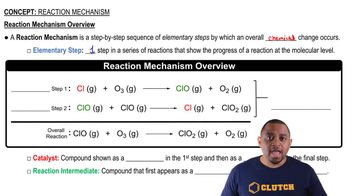
Reaction Mechanism

A reaction mechanism is a step-by-step description of the pathway taken by reactants to form products. It outlines the sequence of elementary reactions, including the formation of intermediates and transition states. Understanding the mechanism helps in predicting the rate and outcome of the reaction, as well as identifying the roles of different species involved.
Video consigliato:
Percorso guidato
03:06
Reaction Mechanism Overview

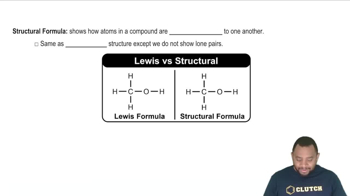
Structural Formulas

Structural formulas represent the arrangement of atoms within a molecule, showing how atoms are bonded together. They provide insight into the molecular geometry and functional groups present in each species. Writing structural formulas is essential for identifying the chemical nature of reactants, products, intermediates, and catalysts in a reaction.
Video consigliato:
Percorso guidato
01:00
Structural Formula

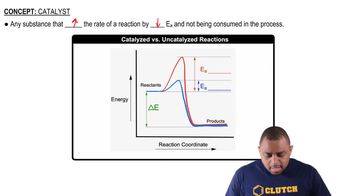
Catalysts and Intermediates

Catalysts are substances that increase the rate of a reaction without being consumed, while intermediates are transient species formed during the reaction that are not present in the final products. Recognizing these roles is crucial for understanding the overall reaction dynamics and energy changes, as intermediates often have distinct structural features that can be identified in the reaction mechanism.
Video consigliato:
Percorso guidato
01:59
Catalyzed vs. Uncatalyzed Reactions