
Ch.14 - Chemical Kinetics
McMurry - Chemistry 8th Edition
McMurry8th EditionChemistryISBN: 9781292336145Non è quello che usi tu?Cambia libro di testo
Capitolo 14, Problema 41b

Consider the first-order decomposition of A molecules (red spheres) in three vessels of equal volume. (1)-(3)
(b) What are the relative half-lives of the reactions in vessels (1)–(3)?

Guida verificata passo dopo passo
1
Step 1: Understand the concept of half-life. The half-life of a reaction is the time it takes for the concentration of the reactant to decrease to half of its initial value. For a first-order reaction, the half-life is independent of the initial concentration of the reactant.
Step 2: Apply the concept to the problem. Since the decomposition of A is a first-order reaction, the half-lives of the reactions in all three vessels are the same, regardless of the initial concentration of A in each vessel.
Step 3: Therefore, the relative half-lives of the reactions in vessels (1)-(3) are equal. This is because the half-life of a first-order reaction is determined only by the rate constant, not the initial concentration.
Step 4: Remember that the rate constant is a characteristic of the particular reaction at a given temperature, and does not change with the concentration of the reactant.
Step 5: In conclusion, for first-order reactions, the half-life is constant and does not depend on the initial concentration of the reactant. Therefore, the relative half-lives of the reactions in vessels (1)-(3) are equal.

Risposta video verificata per un problema simile:

Questa soluzione video è stata consigliata dai nostri tutor come utile per risolvere questo problema.
Durata del video:
1m

Concetti chiave

Ecco i concetti essenziali che devi comprendere per rispondere correttamente alla domanda.

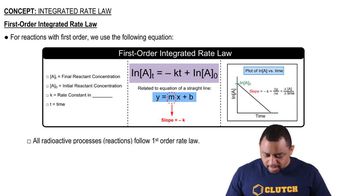
First-Order Reactions

First-order reactions are chemical reactions where the rate is directly proportional to the concentration of one reactant. This means that as the concentration of the reactant decreases, the rate of reaction also decreases. The mathematical representation of a first-order reaction is given by the equation: rate = k[A], where k is the rate constant and [A] is the concentration of reactant A.
Video consigliato:
Percorso guidato
02:29
First-Order Reactions

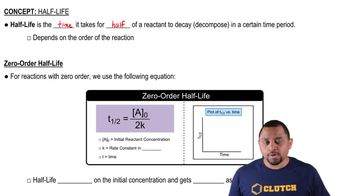
Half-Life

The half-life of a reaction is the time required for the concentration of a reactant to decrease to half of its initial value. For first-order reactions, the half-life is constant and does not depend on the initial concentration of the reactant. The half-life can be calculated using the formula: t1/2 = 0.693/k, where k is the rate constant.
Video consigliato:
Percorso guidato
02:17
Zero-Order Half-life

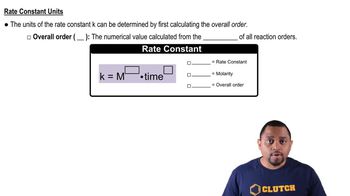
Reaction Conditions and Rate Constants

The rate constant (k) for a reaction can vary based on factors such as temperature, pressure, and the presence of catalysts. In the context of the question, if the vessels (1)-(3) have different conditions (e.g., temperature), the rate constants will differ, leading to variations in half-lives. Understanding how these conditions affect k is crucial for determining the relative half-lives of the reactions in the different vessels.
Video consigliato:
Percorso guidato
00:45
Rate Constant Units
Pratica correlata
Domanda del libro di testo
Consider the first-order decomposition of A molecules (red spheres) in three vessels of equal volume. (1)-(3)

(c) How will the rates and half-lives be affected if the volume of each vessel is decreased by a factor of 2?
472
views
Domanda del libro di testo

The following reaction is first order in A (red spheres) and first order in B (blue spheres): A + B → Products Rate = k[A][B]

(b) What are the relative values of the rate constant k for vessels (1)–(4)?

298
views
Domanda del libro di testo
Consider the first-order reaction AS B in which A molecules (red spheres) are converted to B molecules (blue spheres).

(a) Given the pictures at t = 0 min and t = 1 min, draw pictures that show the number of A and B molecules present at t = 2 min and t = 3 min.
766
views
Domanda del libro di testo

The following reaction is first order in A (red spheres) and first order in B (blue spheres): A + B → Products Rate = k[A][B]

(a) What are the relative rates of this reaction in vessels (1)–(4)? Each vessel has the same volume.

476
views
1
rank
Domanda del libro di testo

The following pictures represent the progress of the reaction AS B in which A molecules (red spheres) are converted to B molecules (blue spheres).

(c) Suppose that each sphere represents 6.0⨉1021 molecules and that the volume of the container is 1.0 L. What is the rate constant for the reaction in the usual units?

519
views
Domanda del libro di testo

The following pictures represent the progress of the reaction AS B in which A molecules (red spheres) are converted to B molecules (blue spheres).

(b) Draw a picture that shows the number of A and B molecules present at t = 3 min.

620
views
1
rank