

Ch.14 - Chemical Kinetics
McMurry - Chemistry 8th Edition
McMurry8th EditionChemistryISBN: 9781292336145Non è quello che usi tu?Cambia libro di testo
Capitolo 14, Problema 42

Consider the first-order reaction AS B in which A molecules (red spheres) are converted to B molecules (blue spheres). At t=0s, all molecules are A (gray spheres).
(a) Given the pictures at t = 0 min and t = 1 min, draw pictures that show the number of A and B molecules present at t = 2 min and t = 3 min.

Guida verificata passo dopo passo
1
Step 1: Observe the initial state at t = 0 s where all molecules are A (gray spheres).
Step 2: Observe the state at t = 30 s where some A molecules have been converted to B molecules (red spheres).
Step 3: Determine the number of A and B molecules at t = 30 s. Count the gray and red spheres.
Step 4: Use the observed conversion rate from t = 0 s to t = 30 s to predict the number of A and B molecules at t = 60 s (1 min).
Step 5: Continue using the same conversion rate to predict the number of A and B molecules at t = 90 s (1.5 min) and t = 120 s (2 min).

Risposta video verificata per un problema simile:

Questa soluzione video è stata consigliata dai nostri tutor come utile per risolvere questo problema.
Durata del video:
2m

Concetti chiave

Ecco i concetti essenziali che devi comprendere per rispondere correttamente alla domanda.

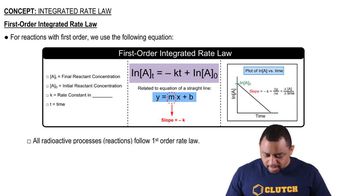
First-Order Reaction

A first-order reaction is a type of chemical reaction where the rate is directly proportional to the concentration of one reactant. This means that as the concentration of reactant A decreases, the rate at which it converts to product B also decreases. The rate law for a first-order reaction can be expressed as rate = k[A], where k is the rate constant.
Video consigliato:
Percorso guidato
02:29
First-Order Reactions

Reaction Progress Over Time

In a first-order reaction, the conversion of reactants to products occurs over time, and the concentration of reactants decreases while the concentration of products increases. The graphical representation of this process typically shows an exponential decay for reactants and an exponential growth for products. Understanding this progression is crucial for predicting the amounts of A and B at any given time.
Video consigliato:
Percorso guidato
02:16
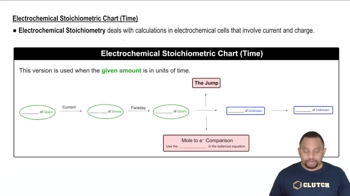
Electrochemical Stoichiometric Chart (Time)

Stoichiometry

Stoichiometry involves the calculation of reactants and products in chemical reactions based on their molar ratios. In this context, it helps determine how many molecules of A are converted to B over time. For a first-order reaction, knowing the initial concentration of A allows for the calculation of remaining A and formed B at any time, which is essential for drawing the required pictures.
Video consigliato:
Percorso guidato
01:16
Stoichiometry Concept
Pratica correlata
Domanda del libro di testo
Consider the first-order decomposition of A molecules (red spheres) in three vessels of equal volume. (1)-(3)

(c) How will the rates and half-lives be affected if the volume of each vessel is decreased by a factor of 2?
472
views
Domanda del libro di testo

Consider the first-order decomposition of A molecules (red spheres) in three vessels of equal volume. (1)-(3)

(b) What are the relative half-lives of the reactions in vessels (1)–(3)?

583
views
Domanda del libro di testo

The following reaction is first order in A (red spheres) and first order in B (blue spheres): A + B → Products Rate = k[A][B]

(b) What are the relative values of the rate constant k for vessels (1)–(4)?

298
views
Domanda del libro di testo
The following pictures represent the progress of a reaction in which two A molecules combine to give a more complex molecule A2, 2 AS A2.

(b) What is the rate law?
578
views
Domanda del libro di testo

The following pictures represent the progress of the reaction AS B in which A molecules (red spheres) are converted to B molecules (blue spheres).

(c) Suppose that each sphere represents 6.0⨉1021 molecules and that the volume of the container is 1.0 L. What is the rate constant for the reaction in the usual units?

519
views
Domanda del libro di testo

The following pictures represent the progress of the reaction AS B in which A molecules (red spheres) are converted to B molecules (blue spheres).

(b) Draw a picture that shows the number of A and B molecules present at t = 3 min.

620
views
1
rank