
Ch.14 - Chemical Kinetics
McMurry - Chemistry 8th Edition
McMurry8th EditionChemistryISBN: 9781292336145Non è quello che usi tu?Cambia libro di testo
Capitolo 14, Problema 126a

Consider the following concentration–time data for the reaction of iodide ion and hypochlorite ion (OCl-). The products are chloride ion and hypoiodite ion (OI-).
(a) Write a balanced equation for the reaction.

Guida verificata passo dopo passo
1
Identify the reactants and products in the reaction: iodide ion (I^-), hypochlorite ion (OCl^-), chloride ion (Cl^-), and hypoiodite ion (OI^-).
Write the unbalanced chemical equation using the chemical formulas of the reactants and products: I^- + OCl^- -> Cl^- + OI^-.
Balance the equation by ensuring the number of each type of atom is the same on both sides of the equation.
Check the charges on both sides of the equation to ensure they are balanced. The total charge on the reactant side should equal the total charge on the product side.
Verify that the balanced equation follows the law of conservation of mass, meaning the mass of the reactants equals the mass of the products.

Risposta video verificata per un problema simile:

Questa soluzione video è stata consigliata dai nostri tutor come utile per risolvere questo problema.
Durata del video:
1m

Concetti chiave

Ecco i concetti essenziali che devi comprendere per rispondere correttamente alla domanda.

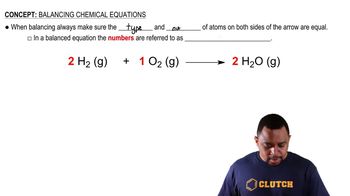
Balancing Chemical Equations

Balancing chemical equations involves ensuring that the number of atoms for each element is the same on both the reactant and product sides. This is based on the law of conservation of mass, which states that matter cannot be created or destroyed in a chemical reaction. To balance an equation, coefficients are adjusted in front of the chemical formulas to achieve equal atom counts.
Video consigliato:
Percorso guidato
01:32
Balancing Chemical Equations

Ionic Compounds and Reactions

Ionic compounds consist of positively and negatively charged ions. In the given reaction, iodide ion (I<sup>-</sup>) and hypochlorite ion (OCl<sup>-</sup>) react to form chloride ion (Cl<sup>-</sup>) and hypoiodite ion (OI<sup>-</sup>). Understanding the behavior of these ions in solution is crucial for predicting the products of the reaction and writing the balanced equation.
Video consigliato:
Percorso guidato
02:11
Ionic Compounds Naming

Reaction Products

Identifying reaction products is essential for writing balanced equations. In this case, the reaction between iodide and hypochlorite ions produces chloride and hypoiodite ions. Recognizing the nature of the reactants and the expected products helps in formulating the correct balanced equation, which reflects the transformation occurring during the reaction.
Video consigliato:
Percorso guidato
01:30
Production of Hydrogen Example
Pratica correlata
Domanda del libro di testo

Consider the reaction H2(g) + I2(g) → 2 HI(g). The reaction of a fixed amount of H2 and I2 is studied in a cylinder fitted with a movable piston. Indicate the effect of each of the following changes on the rate of the reaction. (c) The addition of a catalyst

266
views
Domanda del libro di testo

Consider the following concentration–time data for the reaction of iodide ion and hypochlorite ion (OCl-). The products are chloride ion and hypoiodite ion (OI-).

(b) Determine the rate law, and calculate the value of the rate constant.

673
views
Domanda del libro di testo

Consider the reversible, first-order interconversion of two molecules A and B: where kf = 3.0⨉10-3 s-1 is the rate constant for the forward reaction and kr = 1.0⨉10-3 s-1 is the rate constant for the reverse reaction. We'll see in Chapter 15 that a reaction does not go to completion but instead reaches a state of equilibrium with comparable concentrations of reactants and products if the rate constants kf and kr have comparable values.

(a) What are the rate laws for the forward and reverse reactions?

453
views
Domanda del libro di testo
Concentration–time data for the conversion of A and B to D are listed in the following table. (c) What is the rate law?

711
views
Domanda del libro di testo

Consider the following concentration–time data for the reaction of iodide ion and hypochlorite ion (OCl-). The products are chloride ion and hypoiodite ion (OI-).

(d) Propose a mechanism that is consistent with the rate law, and express the rate constant in terms of the rate constants for the elementary steps in your mechanism. (Hint: Transfer of an H+ ion between H2O and OCl- is a rapid reversible reaction.)

288
views